

CEO and board AI advisory · Technical due diligence
AI strategy for operators, by an operator.
I help the CEOs and boards of $20–250M companies build AI strategy without the hype, and test the AI claims in the deals they are buying or preparing to sell. Multiple CEO tenures. Ten years of M&A. A hands-on AI lab.
I’ll tell you when the AI is not what you may think. That conversation saves more money than any deployment I could recommend.
- CEO tenures
- Multiple
- software and IT-services M&A
- 10 years
- secure research lab, hands-on
- AI Lab
- nothing to implement or sell
- Independent
Why this is different
Most AI advisors have never run a company. Most diligence teams don’t understand the limitations of the technology.
- 01
An operator, not a framework
Strategy consultants understand frameworks and AI vendors understand their products. Very few understand both the technology and what it takes to run a company through an inflection point. I have been the CEO who owned that call.
- 02
Tested, not read back
The standard AI diligence is document review and an interview with the engineering team. Necessary, not sufficient. Where scope allows and the data is shared, I test data readiness and specific claims hands-on in my own lab, at scale on rented GPUs when needed.
- 03
Nothing to sell you afterwards
No implementation arm and no vendor to sell. The only deliverable is a clear read on where AI is worth doing, what it can and cannot do, and what it would take to find out.
Where I can help
One practitioner, two ways to work together.
Advisory is the core of the practice. Technical due diligence applies the same method to a deal: test the claim, state the limits.
What advisory looks like
Strategic clarity. Not another technology project.
The question I help CEOs answer is not “how do we implement AI?” It is the harder one before that: should we, where, and what does it change about our competitive position?
Strategic sessions
Working sessions on the AI decisions you are actually facing: vendor proposals, team recommendations, competitive moves, and the questions your board is asking. I bring a prepared analysis each time.
Board education
A structured working session for directors: how AI creates and destroys value, what the board’s oversight role should be, and the questions to put to management. Not a keynote.
Board preparation
Independent review of management’s AI proposals, with a risk view ahead of relevant votes or capital allocations, presented to the board where that helps.
Bounded project work
Discrete questions answered with evidence: an AI opportunity assessment with an ROI model, a vendor evaluation, or an AI hiring strategy. Scoped and agreed separately.
AI Lab · The technical edge
I don’t just advise on AI. I run it.
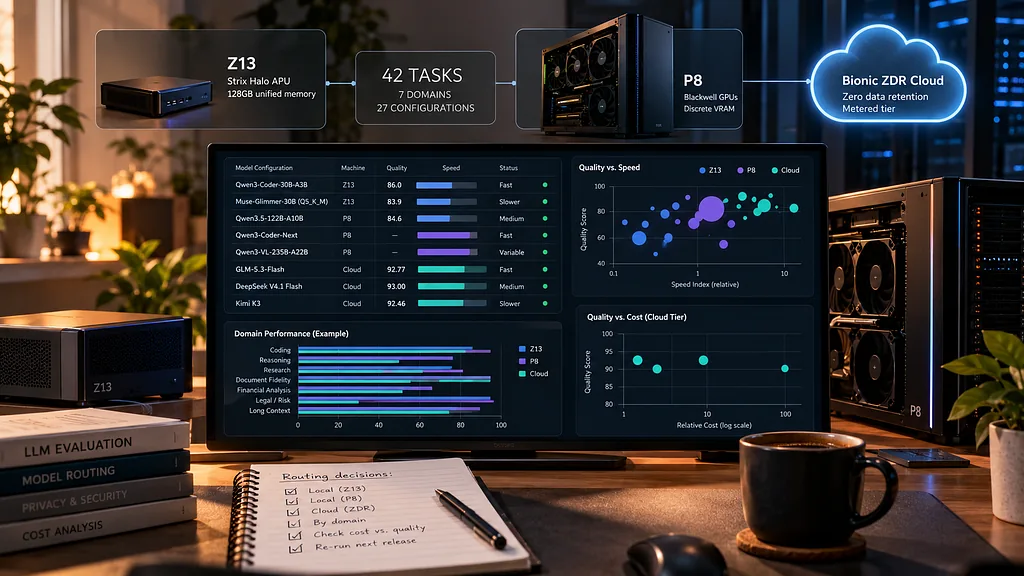
When I tell a CEO whether their data can support an AI initiative, it rests on direct evaluation of the data they share, in a secure research lab, not on secondhand analysis. Where the question is scale, I rent the GPU capacity to test it. I say so when a question is beyond the lab.
- 01
Assess data readiness
With data you choose to share, check coverage, quality, consistency, labelling, and whether it can support the use case you have in mind.
- 02
Try the idea on your data
Run experiments with open and commercial models on a sample of your data, or at full scale on rented GPUs, to see whether an approach is feasible before you commit budget.
- 03
Test claims, including at scale
Test specific claims where the configuration and data are shared: accuracy, throughput, latency, and cost per request under load, on rented GPU capacity when the lab’s own machines are not enough. Anything not tested is reported as not tested.
- 04
Stay current
Work hands-on with new model releases, so advice reflects how they behave in practice and not only how they are marketed.
Diligence deliverables
For deals: a report your deal team can act on, not a slide deck.
Every finding is traced to its evidence, with the limits of that evidence stated plainly.
- What management claimed, and which of those claims we tested
- The evidence we observed, and the limits of that evidence
- Severity and confidence for each finding, stated in words
- Open questions to resolve before signing
- Recommended follow-up, with a named owner for each item
- 01
Model accuracy holds on the customer’s own data
Partly supported
Benchmark run on the vendor’s sample set only. No customer-data run was provided.
Severity: MediumConfidence: High
- 02
Inference cost per request falls as usage scales
Not supported
No cost-per-request data in the data room. Pricing terms imply the opposite at current volumes.
Severity: HighConfidence: Medium
- 03
Training data is owned outright
Open question
Licence terms for two source datasets were not provided. Ownership cannot be confirmed.
Severity: HighConfidence: Low
Authored for illustration. Not a completed engagement, and it contains no client, employer, or target material.
How a diligence engagement works
Four steps, with access timing agreed up front.
Access and scheduling are the usual reasons diligence runs late. We agree both before the clock starts.
- 1
Scope and conflict check
We confirm the decision, the target type, your timetable, and any conflict with the target or its advisers. Then we agree written terms.
- 2
Authorized access
Data room or management access under written terms. Access timing sets the start date, so we agree it before kickoff.
- 3
Review and testing
Document review, management interviews, and research-lab testing where the agreed scope includes it.
- 4
Findings readout
A written report and a walkthrough with your deal team, with every finding traced to its evidence.

Why this principal
I’ve been the CEO. I’ve been the advisor. Now I check the claims.
Ten years of software and IT-services M&A, multiple CEO tenures, and a secure AI research lab. Diligence on AI is only as good as the person checking the claims.
- Multiple CEO tenures, including a research firm and a technology portal
- Ten years of software and IT-services M&A, across transactions and integrations
- Former OSINT practitioner
- Has a secure AI research lab for hands-on work on data readiness and feasibility
Insights
From the thinking.
Learnings on AI strategy, governance, and M&A. Original analysis from direct advisory and diligence work.


Research
Four weekly briefings, written for executives and boards.
Writing that doesn’t repeat what you already read. Each issue is a dashboard and a matching PDF, free, with sources and reporting windows shown.
Let’s find out if there’s a fit.
I don’t run a sales process. Tell me the decision in front of you and your timetable. I take a small number of engagements at a time, so I confirm fit, availability, and conflicts first.
Prefer email? inquiries@analyticaloutcomes.com