
January 2026 AI Update:
The $6 Million Model That Broke AI Economics: What this Reveals About the Real Race

Let’s start with the number that broke everything: $6 million.
That’s what DeepSeek — a Chinese research lab — spent on the final training run of R1, an open-source reasoning model that outperforms GPT-4 o1-mini. Not $100 million. Not $50 million. Six million for the marginal training cost.
However, critical context matters here. DeepSeek’s total infrastructure investment approaches $1.6 billion for approximately 50,000 Nvidia GPUs. The $6 million figure represents the cost of the final training iteration, not the full capital expenditure or R&D overhead. As U.S. AI Czar David Sacks clarified, this “does not include capital expenditures or R&D, and at best refers only to the cost of the final training run”.
But even accounting for infrastructure costs, the efficiency breakthrough is real. DeepSeek’s reinforcement learning training run cost just $294,000. Their architectural innovations — Mixture of Experts, Multi-head Latent Attention, and RL without supervised fine-tuning — cut inference costs by 93.3% through reduced key-value caching. The model is open source, the reasoning process is transparent and you can watch it work through problems like math homework.
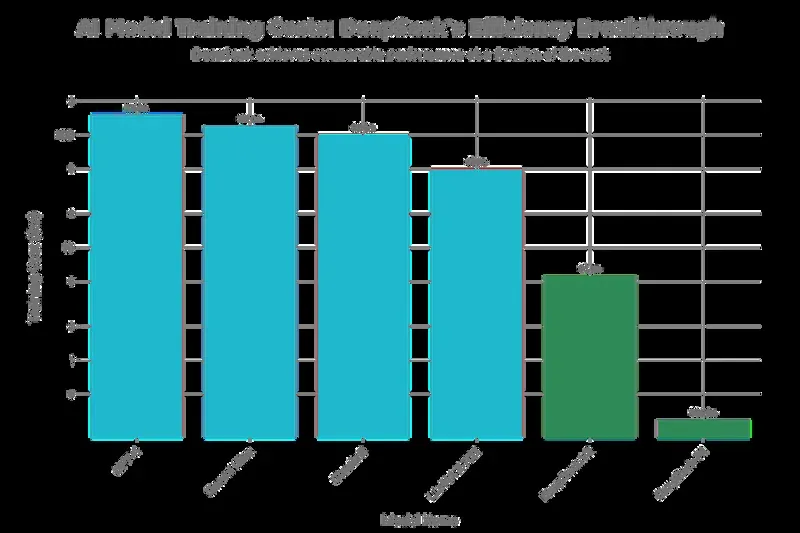
OpenAI’s reported $100 million GPT-4 training cost similarly excludes substantial infrastructure and R&D investments. The real story isn’t absolute cost reduction — it’s marginal efficiency. Once infrastructure exists, subsequent model iterations cost dramatically less. And Western competitors can adopt these innovations rapidly, potentially eroding China’s advantage within 12–18 months.
Nevertheless, that $6 million marginal cost is still less than most Series A companies spend on cloud infrastructure annually. If your AI strategy assumed frontier models required nine-figure training runs, January 2026 just invalidated your roadmap.
But DeepSeek wasn’t even the biggest story of the week.
Meta Paid $2 Billion for Something OpenAI Couldn’t Build
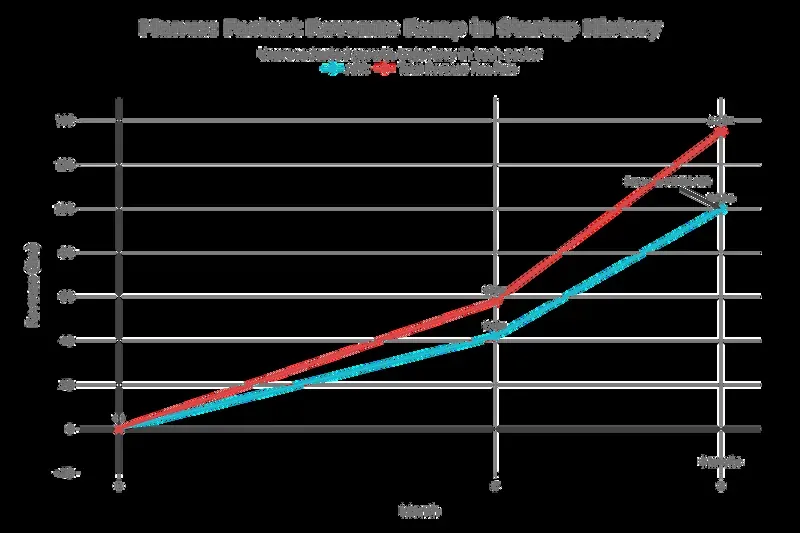
On January 5, Meta acquired Manus — a Singaporean AI agent startup — for over $2 billion. Manus hit $100 million in ARR in eight months, with $90 million reached at five months. That’s the fastest revenue ramp in startup history.
Remarkably, the deal closed in approximately ten days. Meta bought out all of the Chinese investors and will cease China operations to avoid regulatory friction. This wasn’t only about smoothing CFIUS approval — it was about eliminating ongoing compliance burdens entirely.
Meta didn’t buy model architecture — they bought execution infrastructure. Autonomous agents that perform market analysis, write code, and evaluate data without human supervision. Millions of users have already deployed and revenue is scaling faster than any SaaS company in history — faster than Slack (18 months to $100M ARR) and faster than Zoom (roughly 24 months).
Critical Perspective
Meta paid over 16x ARR for an eight-month-old startup. This valuation embeds extreme assumptions about sustained growth and competitive moats. If foundation models continue improving reasoning capabilities — as OpenAI o1’s 77% GPQA Diamond accuracy suggests — the integration layer Manus provides may prove less defensible than current valuations imply. Microsoft’s aggressive Dynamics 365 agent rollout and open-source agent frameworks could commoditize agent orchestration within 24 months.
The foundation model era just ended. The agent era started.
Here’s the shift: foundation models became table stakes. Multiple frontier models demonstrate extraordinary capability, though specific performance hierarchies continue to evolve. While all of them are remarkable, none of them generate revenue without a deployment strategy.
Microsoft’s Dynamics 365 is expected to launch agentic features in February 2026, together with a preview of Commerce MCP Server. This will allow retailers to build autonomous customer experiences.
Windows 11 is actively pushing developers to build agents, not apps, with native Model Context Protocol (MCP) support, “experiential agentic experiences” toggles in preview builds, and the Agent Launchers framework for third-party integration.
Adoption Reality Check
Industry analysts predict approximately 40% of enterprise applications will embed AI agents by year-end 2026 — not the 80% figure sometimes cited in promotional materials. Separately, 81% of organizations plan to expand into more complex agent use cases, but planning doesn’t equal deployment.
The agent transformation is real, but enterprise procurement cycles, integration complexity, and organizational change management create friction that slows adoption below technology readiness.
Note that the 40% figure still represents contracted deployment at unprecedented scale, not speculation.
The Benchmark Problem Nobody’s Talking About
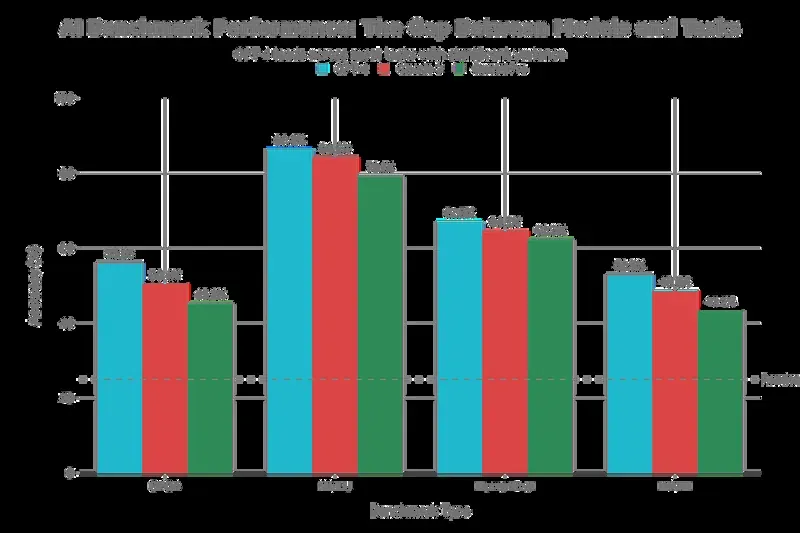
GPQA Diamond — designed to assess expert-level reasoning — shows OpenAI o1 at 77.3% accuracy versus GPT-4’s 39%, exceeding even PhD expert performance (~69.7%). This is a real capability gap that has been validated by peer review and expert comparison.
But MMMU-Pro, designed to test multi-modal understanding through adversarial design that defeats simple information retrieval, reveals frontier models only achieving 16.8%–26.9% accuracy. This spread suggests we’re measuring proxies, not intelligence.
More interesting: live evaluation has replaced static tests, highlighting that agency matters more than accuracy. “Google-proof” standards now prevent overfitting. The gap between what models can do (high scores on traditional benchmarks) and what they actually understand (struggling with true multimodal reasoning) is widening.
Strategically, organizations optimizing for conventional benchmarks may miss capabilities critical for real-world deployment. The measurement tools themselves lag behind deployment needs.
China Isn’t Playing the Same Game
At CES 2026, China showcased humanoid robots approaching genuine human-likeness.
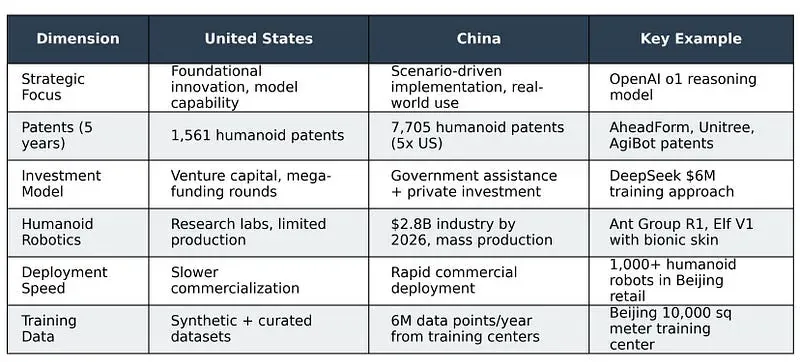
AheadForm Technology’s Elf V1 features 30 facial “muscles” driven by brushless micro-motors, bionic skin with low-latency emotion recognition, synchronized speech, and realistic eye movements nearly indistinguishable from humans.
Ant Group’s R1 robot learns recipes, operates kitchen equipment (woks, stoves) and performs pharmaceutical sorting.
The Beijing training center, the largest in China at over 10,000 square meters, generates an estimated 6 million data points annually. China’s humanoid robot industry will exceed $2.8 billion (20 billion yuan) by year-end, with over 150 companies operating domestically.
Patent Dominance Tells the Strategic Story
China has filed 7,705 humanoid-related patents over the past five years versus 1,561 for the United States — a 5x advantage. China accounts for 54% of global industrial robot deployments and by 2029, is targeting 33% of the global humanoid market.
The dynamic is clear: US leads foundational innovation while China leads scenario-driven implementation. DeepSeek’s marginal efficiency — even accounting for infrastructure costs — demonstrates that capital requirements can be bypassed, or dramatically reduced, at frontier performance levels.
There’s an alternative interpretation — China’s patent volume advantage might reflect different filing strategies rather than genuine innovation leadership. However, rapid commercialization evidence — the 1,000th UBTech S2 robot manufactured, humanoid robots integrated into Beijing retail stores and mass production at scale suggests patents translate quickly into deployed products. The question isn’t whether China leads implementation; it’s whether the U.S. can accelerate deployment fast enough to maintain competitive positioning.
Infrastructure Is the Real Bottleneck
AI data centers now run 2 GPUs per CPU, versus the traditional 4–8 ratios. This shift reflects rapid hybrid orchestration managing GPU, CPU, NPU, and TPU simultaneously in single systems. And optical networking that reduces latency is replacing copper interconnects.
Orbital data centers — solar-powered, radiating heat to space — has moved from concept to engineering discussion. When single high-density AI servers consume 8+ kW and 10-GPU racks require 80+ kW, eliminating cooling infrastructure becomes an economic necessity.
However, orbital data center timelines remain highly speculative. Concept-to-deployment for space-based infrastructure typically requires 7–10 years. Despite the hype, this is active R&D and not imminent deployment.
Server refresh cycles are accelerating beyond the traditional 3–5 year timelines, with organizations migrating entire fleets to mixed CPU/GPU configurations. Oracle announced a 50,000 GPU initial deployment starting in 2026; with industry targets reaching 50 million GPUs over the next five years.
The M&A Inversion
Global M&A deal value in 2025 closed at $2.6 trillion, up 28% year-over-year. AI drove consolidation.
Here’s the inversion: while deal volume increased 28%, the number of transactions decreased 16%. It’s the mega-deals that are driving activity — companies making larger, strategic acquisitions rather than incremental consolidation.
Q4 2025 saw meaningful AI transactions moving beyond pilot programs into operational deployment. Corporate Finance Associates’ managing director described it as “the moment that really matters.” Industry forecasts predict a fundamentally different M&A environment within 3–5 years, with premium multiples on data-rich, globally scalable firms.
OpenAI hit $500 billion valuation in October 2025, surpassing SpaceX ($400 billion) as the world’s most valuable private company. Current and former employees sold approximately $6.6 billion in shares and revenue reached ~$4.3 billion in H1 2025–16% above all of 2024.
Anthropic reached $183 billion valuation in September 2025, more than doubling from $61.5 billion just six months earlier. The company raised $13 billion in Series F funding and exceeded $5 billion revenue run rate by August 2025.
Valuation Risk Assessment
These figures embed extraordinary growth assumptions. OpenAI trades at approximately 58x forward revenue (assuming $8.6B annual run rate); Anthropic at roughly 37x.
If AI monetization disappoints — due to commoditization, regulatory constraints, or intensifying competition — these valuations face a severe risk of correction. Historical analogs (dot-com bubble valuations, clean-tech collapse 2008–2012), although not quite comparable, suggest markets systematically overestimate emerging technology adoption timelines.
Both companies secured major government contracts. The Department of Defense awarded up to $200 million each to OpenAI, Anthropic, xAI, and Google in July 2025 for agentic AI workflows in national security missions. The demand is there.
Anthropic offered Claude to “all three branches of government” for $1 in August 2025 — a strategic federal foothold covering executive, legislative, and judiciary, broader than OpenAI’s executive-only offering. Government adoption accelerates commercial credibility.
Strategic Analysis of the $1 Pricing
This is classic loss-leader positioning. Federal adoption creates credibility signaling that accelerates enterprise sales, generates proprietary training data from government use cases, establishes vendor lock-in through workflow integration, and builds regulatory influence.
However, federal contracts carry geopolitical compliance burdens — as seen with Benchmark’s Manus investment scrutiny — that can limit operational flexibility.
Policy Became Product Strategy
AI readiness is now a market-access decision. Export controls, data localization, spectrum policy, and sector-specific mandates all shape deployment feasibility.
Boards are mapping policy through emerging six-step frameworks: mapping exposure to export controls and data residency requirements, linking scenarios to specific workloads, designing jurisdictional architecture, budgeting for regulatory change, coordinating cross-functionally, and tracking performance metrics on delays and approvals.[92]
Meta’s Manus Acquisition Demonstrates Policy-as-Product
All Chinese investors were bought out to prevent CFIUS blocking and China operations were terminated to avoid ongoing compliance burdens. This is deal structure designed to receive regulatory approval within weeks, not months.
Huawei announced a 6G “Agentic-AI Core” (A-Core). These are networks that generate, update, and execute control procedures without human intervention. Presented initially at the Abu Dhabi 6G Summit in November 2024, the technology blueprint represents Huawei’s positioning for standards-setting influence.
When telecommunications infrastructure becomes self-managing, network operations and AI operations merge completely. While 6G standards won’t be finalized until 2027–2028, with commercial deployment expected 2030+, this announcement is strategic positioning for standards-setting rather than near-term capability.
But standards battles matter — winners shape the infrastructure layer for decades.
Video Generation Crossed the Threshold
CraftStory’s Model 2.0, announced January 7, generates 80-second walk-and-talk videos with maintained visual consistency scene-to-scene. The underlying technology is a proprietary parallelized diffusion pipeline trained on high-frame-rate actor footage. This captures facial expressions, hand motions and body language. It supports moving cameras and outputs 480p/720p (upscalable to 1080p) in both landscape and portrait orientations. Image-to-video capability eliminates the need for source footage.
CEO Victor Erukhimov previously sold computer vision company Itseez to Intel, establishing technical credibility. This is shipping product, not vaporware.
NVIDIA’s new Alpamayo platform provides open-source reasoning models, datasets, and simulation for autonomous driving. Mercedes-Benz CLA will be the first production vehicle with the full Nvidia AV stack, expected to launch in Q1 2026 in the United States.
The CLA will launch with Level 2+ autonomy — requiring constant human attention and supervision — not Level 4 autonomy as sometimes reported. Level 4 (vehicle handles all driving tasks autonomously within defined operational domains) remains a future goal.
This distinction matters enormously for regulatory frameworks, insurance structures, and liability allocation.
The Alpamayo 1 model is a 10-billion parameter Vision-Language-Action system trained on human-guided rides combined with synthetic data from Nvidia’s Cosmos platform. It uses chain-of-thought reasoning for edge case handling and includes 1,700+ hours of real-world driving data.
The Workflow Compounding Effect
Creators are chaining ChatGPT, Gemini, and NotebookLM into automated pipelines. While NotebookLM organizes up to 300 sources, Gemini transforms content into articles and summaries and ChatGPT refines tone and generates social content.
Google’s AI Overview prioritizes structured, cited, semantically relevant content. Each article improves system performance, so implementation can generate a 10× velocity increases when executed correctly.
As agents become more reliable, users will delegate more complex workflows. As workflows become more complex, agents will generate more training data. As training data improves models, reliability will increase further. This creates a self-reinforcing cycle that accelerates capability faster than linear development would predict.
What Changed This Week
The gap between model capability and deployment execution closed faster than anticipated. DeepSeek proved frontier performance doesn’t require $100 million marginal training costs — though infrastructure investments remain substantial. Meta proved agent infrastructure commands premiums exceeding typical foundation model valuations — paying 16x ARR for execution capability. Government adoption proved enterprise credibility follows federal approval, with DoD contracts and $1 federal offerings creating commercial acceleration.
Technology transitions rarely occur in single weeks. January 2026 marked a visible acceleration of trends that have been building since mid-2024 — DeepSeek’s R1 development timeline, Manus’s eight-month growth trajectory, multi-year government procurement processes, and China’s five-year humanoid robotics buildout.
The “single week” framing oversimplifies months of parallel developments reaching simultaneous visibility. The more accurate framing is that January 2026 was when these converging trends became undeniable to boardrooms and budget committees. While the technological capabilities existed, the market recognition crystallized.
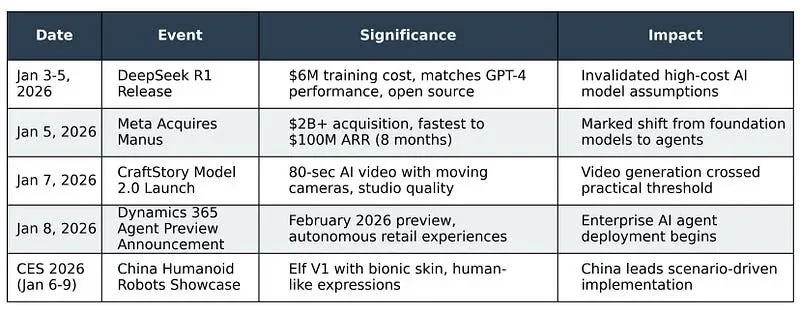
Tthe strategic implications remain identical: Organizations that still treat AI as primarily a foundation model selection problem. Comparing GPT vs. Claude vs. Gemini is solving yesterday’s challenge. The new competitive dimensions are:
1. Execution infrastructure: Can you deploy agents that reliably complete complex, multi-step workflows?
2. Integration architecture: Do your systems allow AI agents to access data and take actions across organizational boundaries?
3. Policy surface area management: Can you navigate export controls, data localization, and sector-specific regulations across jurisdictions?
4. Data moat construction: Are you generating proprietary training data through operational deployment?
Foundation models are commoditizing — DeepSeek’s 33x pricing advantage over GPT-4 ($0.55 vs. $30.00 per million input tokens) signals collapsing margins. But agent orchestration and vertical integration provide the defensible differentiation.
The agentic era doesn’t wait for consensus. And it definitely doesn’t wait for organizations still running nine-month foundation model selection committees.
The companies that moved first on agents are already months ahead. The valuation gap — Manus at 16x ARR, traditional SaaS at 5–8x — reflects markets pricing in this advantage. By the time consensus forms around the agent transition, the competitive moats will already be dug.
That’s what changed this week. Not the technology — the recognition. And in markets, recognition creates reality.
By Ivan Ruzic, Ph.D. · Originally published on Medium