
Something shifted in February 2026. It wasn’t incremental-it was structural.
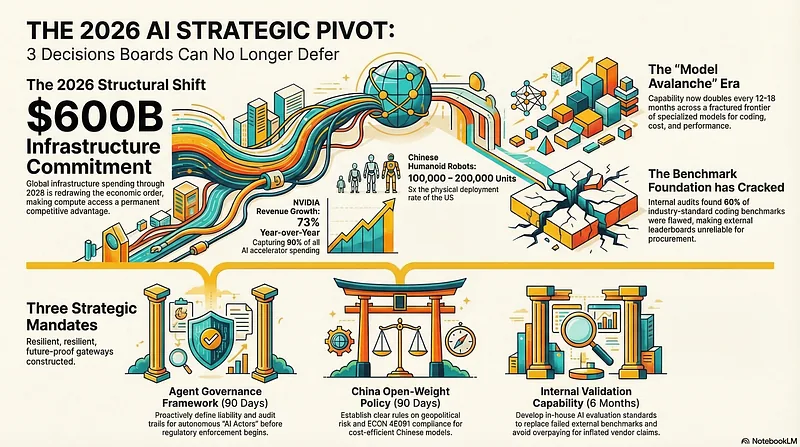
OpenAI raised $110 billion at an $840 billion valuation. Anthropic closed $30 billion at a $380 billion valuation. Meta committed $600 billion in AI infrastructure investment through 2028. These aren’t hedged product bets — they’re declarations that the global economic order is being permanently redrawn, and the organizations making these commitments are buying the rights to sit at the table when the new order settles.
The rest of the business world has a decision to make. It just has less time to make it than most boards currently believe.
The Model Avalanche
February 2026 compressed what used to be a year’s worth of AI capability releases into a matter of weeks. Claude Opus 4.6, GPT-5.3 Codex, Gemini 3.1 Pro, GLM-5, Qwen3.5, Kimi K2.5, and Seedance 2.0 all arrived inside the same short window. Industry observers had a name for it before it finished: the model avalanche.
The frontier has also fractured. There’s no longer a single best AI system. Claude leads in coding workflows. Gemini leads in price-performance. Chinese open-weight models lead in cost efficiency by a margin that deserves far more strategic attention than it currently receives.
The board-level question isn’t which model is best. The question is whether your organization’s AI strategy was built for a world where capability doubles every 12 to 18 months, or for a world where the pace eventually moderates. At this point, there’s no evidence for the latter.
The Infrastructure Bet Is Already Made
NVIDIA now captures approximately 90% of AI accelerator spending, posting $68.1 billion in quarterly revenue. This is a 73% year-over-year increase. That figure represents the largest single technology supply chain in history, measured by concentration and growth simultaneously.
The Meta-NVIDIA multi-generational partnership and Meta-AMD deal (valued at over $100 billion combined) have effectively locked down the GPU supply chain through 2028. Organizations that didn’t reserve compute capacity in 2025 or early 2026 are already structurally disadvantaged. NVIDIA’s Rubin platform, arriving in Q3-Q4 2026, promises approximately five times the inference throughput and ten times the reduction in token costs compared to current hardware. This means that current-generation infrastructure will be partially obsolete within 18 months.
The supply constraint, for now, is compute availability. The asymmetric risk calculus here is rather stark. Over-investing in AI infrastructure carries modest downside: unused capacity can be rented or repurposed. But under-investing carries a different kind of downside; one that compounds silently until it becomes a permanent capability gap against competitors who moved faster and earlier.
China Is Not a Benchmark Curiosity
The dominant Western narrative treats Chinese AI as a reference point for cost efficiency. But that framing misses the strategic picture by a wide margin. Chinese open-weight models-GLM-5, Kimi K2.5, MiniMax M2.5, Qwen3.5-are achieving top-ten positions on independent coding benchmarks. They’re priced 40 to 170 times cheaper than comparable US frontier API access. GLM-5 was trained entirely on 100,000 Huawei Ascend chips. In other words, a frontier-grade AI model was produced without a single NVIDIA chip.
US export controls are now a strategic pressure point, not a decisive gate.
China’s humanoid robot production target is frightening. For 2026, it sits between 100,000 and 200,000 units. Compare this against approximately 16,000 installed globally today, with the majority still in pilot programs. The physical AI deployment rate is roughly five times that of the United States, with significant competitive implications.
ByteDance’s Doubao platform now has 155 million weekly active users. And Seedance 2.0, a video generation model, is generating concern inside Hollywood even before it’s reached full global availability. Organizations treating this as competitive benchmarking should reconsider the frame. What China’s AI sector represents is a structural cost compression on the supply side of intelligence. That compression isn’t temporary, and it will become global.
The Agentic Transition Has Already Begun
The “AI as a tool” era is functionally over, and the “AI as an actor” era has begun — without so much as a press release.
Goldman Sachs, HP, Oracle, State Farm, and Uber are already running AI agents in production workflows. Multi-agent systems, such as Claude Code, GPT-5.3 Codex, and Kimi K2.5’s “Agent Swarm” (100 parallel sub-agents in commercial deployment) are already executing consequential tasks with minimal human review in real business environments today.
However, beware the pitfalls. Internal memos at Amazon recently linked a string of major outages to AI-assisted code that hit production without enough human oversight. While Amazon publicly blamed ‘user error,’ the result was the same: a mandatory new rule that no AI-assisted code moves without a senior engineer’s signature. That’s not a cautionary hypothetical -it happened.
TRM Labs recently identified a massive ‘autonomous AI agent liability gap’ in finance. Basically, when an agent breaks a law at machine speed, we still don’t have a clear legal answer for who pays the fine. That’s why projects like IronCurtain (ironcurtain.dev) launched just last month — it’s an open-source safety layer designed to sandbox these agents before they can do real damage to your system. The governance is lagging behind the tech by a mile.
The decision for organizations isn’t whether to engage with agentic AI. It’s how quickly they can build a formal governance framework-liability assignment, audit trails, permissioning architecture-before regulators establish those standards under less favorable conditions. The cost difference between proactive governance and reactive compliance, post-incident, isn’t marginal. It’s an order of magnitude.
The Benchmark Infrastructure Has Failed
This is the finding that should concern every board with an active AI procurement strategy.
OpenAI retired SWE-Bench Verified-the primary coding benchmark used across the industry-after its own internal audit found that approximately 60% of the hard-level tasks contained flawed or contaminated tests. The benchmark that justified AI vendor selections, procurement decisions, and board-level confidence in capability claims was, at its most favorable, measuring the wrong things.
Voting-based arena leaderboards, such as the LMSYS/LMArena rankings that appear in vendor slide decks and analyst reports, are manipulable. Approximately 1,000 targeted votes can meaningfully shift a model’s Elo ranking. These are the rankings being used to justify purchase decisions.
Fortunately, new credible standards are emerging: SWE-Bench Pro (where top agent scores sit between 55% and 59%, against claims of 80%-plus on the retired Verified benchmark), privately authored expert-graded evaluations, and ARC-AGI-2 as the hardest publicly available test.
Organizations that have built their own internal AI evaluation capability will make better procurement decisions. They’ll avoid overpaying for benchmark-inflated models and will catch vendor marketing claims before those claims become operational problems. The organizations relying on external leaderboards are making governance decisions on a foundation that’s already cracked.
Geopolitical Fragmentation Is a Compliance Cost, Not an Abstract Risk
ECCN 4E091 is now live. Under US export controls, frontier AI models trained on more than 1026 operations are classified as controlled exports. This is the equivalent treatment applied to advanced semiconductors and means that international AI deployments now require export compliance programs, and it applies today.
The domestic US picture is just as complex. The Trump administration’s executive order on AI governance conflicts directly with California’s SB-53, Texas’s RAGAT, and Colorado’s AI Act. Organizations operating across multiple states face confusing and conflicting legal obligations with no clear resolution timeline.
Meanwhile, China is withholding pre-launch access to frontier model training from US chipmakers. This is a reversal of the technical collaboration norms that defined 2021 through 2024. That separation is structural.
Also, the EU AI Act compliance is now binding. For high-risk AI applications, structured risk assessment, documentation, and ongoing monitoring are legal requirements, not best-practice recommendations.
Every board should ask its legal and technology leadership for a current map of AI deployment exposure against these frameworks. The organizations discovering compliance gaps under enforcement conditions will find those gaps far more expensive than those discovered in a policy review.
Physical AI: The Investment Window Before the ‘iPhone Moment’
Robotics is running approximately two to three years behind software AI on the capability curve. Today’s best systems execute coherent autonomous tasks for around 30 minutes. But AI task duration doubles every seven months, by current measurement. This means that eight-hour coherent autonomous operation is projected for late 2026.
The research signal is plain to read. ICLR 2026 received 164 Vision-Language-Action (VLA) papers-18 times the nine submissions from the prior year. That rate of research-to-production orientation mirrors the LLM research pattern from 2020 to 2022, which preceded the GPT-3 and ChatGPT era by roughly 18 months.
NVIDIA’s Isaac GR00T N1.6 is a deliberate platform play-designed as the “Android of robotics” to concentrate the embodied AI value chain the way iOS and Android concentrated mobile computing.
SkildAI ($14 billion valuation), Boston Dynamics/DeepMind, UBTECH (targeting 10,000 humanoid deployments), and AgiBot (holding approximately 39% global share) are the early leaders in a market without an “iPhone moment” — yet. That absence is what makes the investment timing interesting because early exposure carries platform concentration risk and meaningful uncertainty.
The signal to watch for the next stage of commitment: 4-hour coherent autonomous task duration in commercial deployments.
The Three Decisions That Can’t Be Deferred
The strategic intelligence synthesis underlying this analysis identifies three decisions at board level that have crossed from “important” to “urgent”- and where deferral will actively create liability.
Agent Governance Framework — within 90 days. Multi-agent systems are in commercial deployment. The regulatory response to the first significant liability event involving an autonomous AI agent will set standards under adversarial conditions. Proactive governance-policy drafting, audit trail infrastructure, permissioning architecture-costs a fraction of reactive compliance. The decision owners are General Counsel, CTO, and Chief Product Officer, jointly.
Internal Benchmark Validation Capability — within six months. External benchmark infrastructure has demonstrably failed. Organizations without independent AI evaluation capability will overpay for systems, underperform expectations, and face governance scrutiny when AI-driven decisions attract legal attention. This is a strategic function, equivalent in importance to financial auditing.
China Open-Weight Model Policy — within 90 days. Chinese open-weight models are entering enterprise environments through developer adoption, not top-down procurement decisions. Organizations need a stated policy on geopolitical risk tolerance, data sovereignty, and ECCN compliance before de facto adoption creates exposure.
The One-Page Summary the Board Actually Needs
The AI transition no longer resembles a technology adoption cycle. It resembles the early phase of electrification or the commercial internet-a general-purpose infrastructure shift where the question isn’t “whether” but “how fast” and “who captures the value.”
Here are the three structural facts that will govern the next 12 to 18 months:
1. Capital has already committed: $600 billion in 2026 infrastructure investment isn’t contingent on additional breakthroughs.
2. The regulatory window is closing: EU AI Act compliance is live, ECCN 4E091 model weight controls are active, and state-level agent liability frameworks are forming.
3. The workforce transformation is outpacing the reskilling pipeline: Junior developer employment is already down 20%, and the “AI architect plus human reviewer” workflow is the operating standard in leading organizations today-not a 2028 forecast.
The organizations that look back on 2026 as a missed opportunity are the ones that treated it as a year to monitor rather than as a year to act.
By Ivan Ruzic, Ph.D. · Originally published on Medium