

Your acquirer is still paying 8.4x revenue for AI-enabled companies. That window has a closing date. Here’s how to read it.
By the time you read this, a strategic acquirer somewhere is writing a check at a valuation your non-AI competitor couldn’t get close to. The spread between AI-enabled and legacy software companies has never been wider — or more precarious.
In Q1 2026, AI-enabled software commanded an average revenue multiple of 8.4x. Non-AI legacy software companies — the SaaS median excluding AI — closed at roughly 3.2x. That 2.6x gap isn’t a rounding error. It’s the largest capability-driven valuation divergence in tech M&A since the cloud migration wave of 2012–2015. And like that wave, it won’t last forever.
The question founders, boards, and sellers need to answer right now isn’t whether the premium exists — it does. The question is how long acquirers will keep paying it, and what specifically will compress it.
How We Got Here: Six Years in Four Data Points
The acceleration of AI M&A didn’t start with ChatGPT. It started with the infrastructure bets that made ChatGPT possible.
In 2020, AI M&A was a niche category — 2.0–3.0x revenue multiples, mostly data infrastructure and MLOps tooling. Deals were measured in the hundreds, buyers were cautious and AI was a line item in a pitch deck. It wasn’t a valuation driver.
By 2023, that had inverted. ChatGPT’s November 2022 launch reset strategic buyer calculus overnight. AI deal flow hit 450+ transactions and multiples surged to 3.2x. A visible 20%+ premium for AI-capable targets emerged for the first time. This was the origin point of the premium we’re still riding today.
2024 marked the start of the consolidation phase — 600+ AI deals. Multiples reached 3.8x across infrastructure and applications and strategic buyers began competing in earnest. As a result, the AI-driven acquisition premium solidified at 25–30%.
By 2025–2026, the math had compounded. Deal volume exceeded 700 annually, then surged to over 2,000 identified AI deals as of Q1 2026 alone. Multiples settled at 4.2x on the sector-wide median — but that number obscures the real story. AI-enabled software companies (as distinct from the broader AI sector average) were transacting at 8.4x revenue. Foundation model businesses commanded 5.2x on revenue that was often still nascent. Generative AI application companies hit 4.5x, and the entire sector repriced.
Global technology M&A hit a record $4.9 trillion in 2025. Nearly half of all strategic technology deal value above $500 million carried an explicit AI component — up from roughly one in four in 2024.
That ratio doubled in a single year.
The Gap That Should Worry Legacy Sellers
The valuation table below is the most important piece of data in this article for any founder or seller with a non-AI business. Read it carefully.
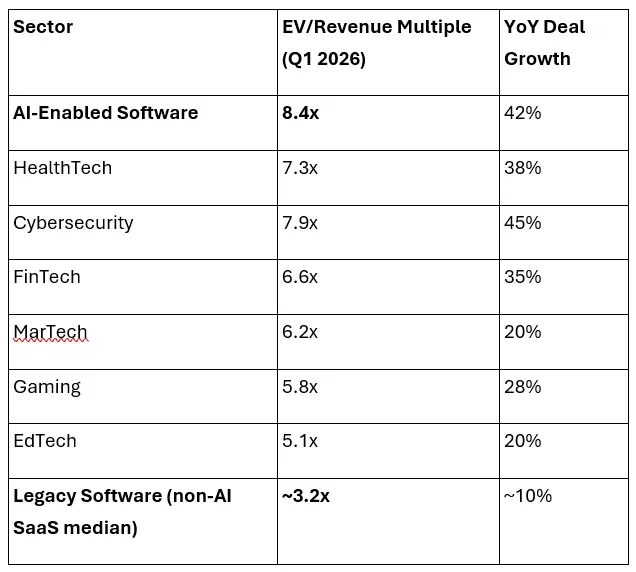
The 8.4x vs. ~3.2x comparison is not sector apples-to-oranges. It’s the same acquirer — a Fortune 1000 corporate development team with a fixed capital allocation budget — choosing between a target with proprietary AI integration and one without. They’re paying more than twice as much per dollar of revenue for the AI-enabled option, and so every year that passes without AI capability is a year of valuation erosion for the legacy seller.
PE firms understand this clearly, and painfully. So far, AI-enabled software has only 18% private equity participation — the lowest of any sector tracked. This is because strategic buyers such as Google, Meta, Microsoft, Salesforce, and dozens of next-tier platforms — are crowding them out.
PE can’t compete when strategic buyers are paying synergy premiums that PE’s IRR math just can’t support. That low PE participation rate is a signal of strategic urgency, not financial speculation.
Why Acquirers Are Paying This Much
The 8.4x multiple isn’t irrational. Acquirers aren’t paying for revenue — they’re paying for four things that revenue proxies for but doesn’t fully capture.
Proprietary data pipelines. The most defensible AI companies aren’t those with the best models. After all, models are increasingly available via API or open-source. They’re the companies that have accumulated labeled, domain-specific training data that competitors can’t replicate at any price. A vertical AI company with five years of healthcare encounter data is not buyable on the open market. The data moat is the acquisition rationale.
Talent that can’t be hired. AI engineering compensation runs at 2–3x traditional software engineering. Senior ML researchers are not on job boards. The acquihire dynamic of buying a company principally for its engineering team has driven significant deal volume at above-market multiples. For example, Ask Sage’s $250M acquisition and BigBear.ai’s defense AI deals both carried implicit acquihire components alongside the product rationale.
Distribution that took years to build. AI capability embedded in a vertical workflow, such as healthcare scheduling, legal document review, or financial risk modeling, commands a premium because of locked distribution. The AI is not the product; the workflow integration is. Replacing it requires replacing the workflow, which enterprise customers resist.
Time compression. The most honest answer acquirers give in deal rationale meetings that I’ve participated in is that building internally would take 18–36 months — and might fail. So, that AI M&A premium is, in part, a speed premium. Companies stuck in pilot mode are acquiring their way to enterprise-wide deployment. The Bain 2026 M&A report found that 80% of M&A executives plan to sustain or increase deal activity specifically to close capability gaps they can’t close organically fast enough.
The $64 Billion Question: How Long Does the Premium Last?
The data supports the premium today. The debate is whether it will persist into 2027 and beyond. There are compelling arguments on both sides, and the answer is likely to be sector-specific rather than binary.
The Case for Persistence (Through 2027–2028)
Structural scarcity is real. Unlike cloud infrastructure, which scaled with commodity hardware, AI capability scales with talent and proprietary data, both of which are genuinely scarce. Model development, inference optimization and AI implementation expertise is concentrated in a few hundred people globally. That scarcity does not resolve quickly.
Enterprise willingness to pay is self-reinforcing. Enterprise customers are paying 30–50% premiums for AI-enabled products over legacy equivalents. When the end customer pays a premium, the acquirer is simply capturing part of that premium at the M&A layer. As long as enterprise AI pricing holds, acquisition multiples have a demand-side anchor.
The historical cloud parallel suggests runway. Cloud infrastructure maintained a 1.5–2x premium over traditional software for five or more years as the market matured (2010–2015). If AI follows a similar arc, and there are reasons to think it will given the depth of workflow transformation required, the premium has meaningful runway remaining.
63% of CEOs plan serious deal activity in 2026. The KPMG CEO Outlook found that a quarter of those CEOs are waiting until 2027. That is not a market pulling back — that is a market building up a demand queue. Deals that close in 2027 will likely reflect multiples shaped by the competition among those waiting buyers.
The Case for Compression (2027–2029)
Open-source commoditization is accelerating. Alibaba’s Qwen releases, Google’s open-weights models, and the broader open-source LLM ecosystem are compressing the proprietary model moat faster than many acquirers anticipated. If any enterprise can download a model nearly as capable as GPT-5 or Claude and fine-tune it on their own data, the premium for accessing or owning a proprietary model shrinks substantially. The question shifts to “do you have the data and workflow integration that makes the model valuable?” — a harder bar, but one that fewer acquisition targets clear.
Growth rates will normalize. AI-enabled targets currently grow at 40–60% annually. However, historical SaaS data shows that growth rates compress 30–40% as markets mature. When AI ARR growth normalizes to 25–35%, the multiple compression logic will follow almost mechanically — the premium was purchased on growth expectations, not on current economics.
PE entry signals late-stage consolidation. AI sector PE participation is currently 18%. This is low, but rising. As PE firms build AI-enabled portfolio platforms and then execute bolt-on strategies, they’ll introduce IRR-disciplined pricing into a market currently dominated by strategic buyers with synergy math. PE’s return requirements will structurally compress multiples over time.
The integration reckoning is coming. Acquirers are beginning to learn, somewhat painfully, that AI targets come with what practitioners are calling an “AI tax”: data quality remediation, model retraining, inference cost scaling, and integration complexity. All of these erode the synergy value in the original deal. As integration lessons accumulate across 2,000+ AI deals, buyer sophistication will sharpen, and that will pressure headline multiples.
The Forecast: A Premium with an Expiration Date by Sector
The AI premium isn’t going to zero anytime soon. But it is going to fragment — and fragment along lines that will matter enormously for exit timing.
The most defensible premium is in companies that combine three things: proprietary domain-specific data that cannot be replicated by open-source models, deep workflow integration that creates genuine switching costs, and demonstrated enterprise revenue at meaningful scale. Companies with all three will continue to command 7–9x revenue multiples through 2027 and likely into 2028.
The most vulnerable premium is in companies that have built a product wrapper around a foundation model API with no proprietary data and limited workflow depth. As open-source parity advances and acquirers become more discerning, that premium will compress toward the 2.5–3.5x range that non-AI SaaS commands at similar growth rates.
The value migration thesis from Amadeus Capital is helpful here: as LLMs commoditize, value flows from the “pipes” (generic models, compute) to the “plumbing” (tooling, safety, data pipelines) and ultimately to the “fixtures” — domain-specific applications with unique distribution. It’s likely the M&A premium will follow that migration, concentrating in vertical AI with proprietary data and workflow depth while compressing in horizontal, API-dependent, data-light products.
Concretely:
• Foundation models (5.2x currently): Premium likely stable through 2026; compression risk as open-source closes capability gap
• Vertical AI applications with proprietary data (8.4x): Most durable premium; defensible through 2027–2028
• ML infrastructure and tooling (4.0x): Moderate compression risk; consolidation wave likely to bifurcate winners and losers
• Horizontal AI feature companies (3.5–4.5x): Highest compression risk; acquirers are already more discerning in 2026 than in 2024
What This Means for Sellers, Boards, and Advisors
If you are a founder of an AI-enabled company: The premium window is open, but it is not infinitely wide. The market’s peak strategic urgency — the period when acquirers are most willing to pay for capability they cannot yet build — is a finite phenomenon. Cloud was roughly five years at peak premium, but AI’s peak may be shorter given the pace of open-source development. Planning a 2026–2027 exit process is not premature; it may be optimal.
If you are a board member of a non-AI technology company: The ~3.2x legacy software median serves as a warning, not a baseline. Every quarter without an AI capability roadmap is a quarter of valuation erosion relative to your AI-enabled competitors. Acquirers are not distinguishing between “AI company” and “non-AI company” as categories. Instead, they’re distinguishing between companies with defensible AI capability and those without. The former are buyable at premium; the latter are buyable at discount or not at all.
If you are an acquirer: The 8.4x multiple is pricing in growth and scarcity that may or may not persist. The due diligence question in 2026 is not “does this company have AI?” because every pitch deck now says yes. The question is “what specifically would take us 18–36 months and $100M to build that this company already has?” If the answer is clear and quantifiable, the premium is defensible. If the answer is “AI positioning and a good team,” the premium is a risk you are taking on.
The Bottom Line
The AI M&A premium is the most significant valuation gap in technology in at least a decade. At 8.4x revenue for AI-enabled software versus ~3.2x for non-AI legacy software, acquirers are making a structural judgment that AI capability is not a feature but a platform shift.
While they’re right about the platform shift, they may be wrong about how long the premium pricing of that shift can be sustained at current multiples.
The window is open, but the timeline is not unlimited. The companies and boards that treat this as a permanent condition will look back on 2026 the way SaaS sellers look back on missed 2021 exits.
The clock is running.
Ivan Ruzic is a Tech M&A advisor and AI consultant specializing in full-cycle M&A strategy for technology companies navigating AI-driven consolidation. He advises boards, founders, and acquirers on deal structuring, valuation positioning, and AI capability assessment.
Sources & Data:
• Sector valuation multiples and deal count data: Corum Group TMS Research, Q1 2026; internal wiki analysis across 28 sector-specific reports
• Global M&A deal value ($4.9T): Bain & Company M&A Report 2026
• AI deal acceleration (90% YoY, Q1 2026): CB Insights via FE International analysis
• AI in strategic deals (50% of deal value): TD Securities M&A Outlook 2026
• CEO deal intentions (63%): KPMG CEO Outlook Pulse 2026
• AI commoditization curve: Amadeus Capital analysis
• LLM market forecast ($14.4B by 2027): LLM-Stats / Finro research
• PE participation and strategic buyer dynamics: internal analysis, Finro AI Valuation dataset Q1 2026
• Legacy/non-AI SaaS median multiple (~3.2x): Aventis Advisors SaaS Multiples 2026; Multiples.vc Public Software Comps April 2026; SaaS Capital Private SaaS Valuations 2025
By Ivan Ruzic, Ph.D. · Originally published on Medium