
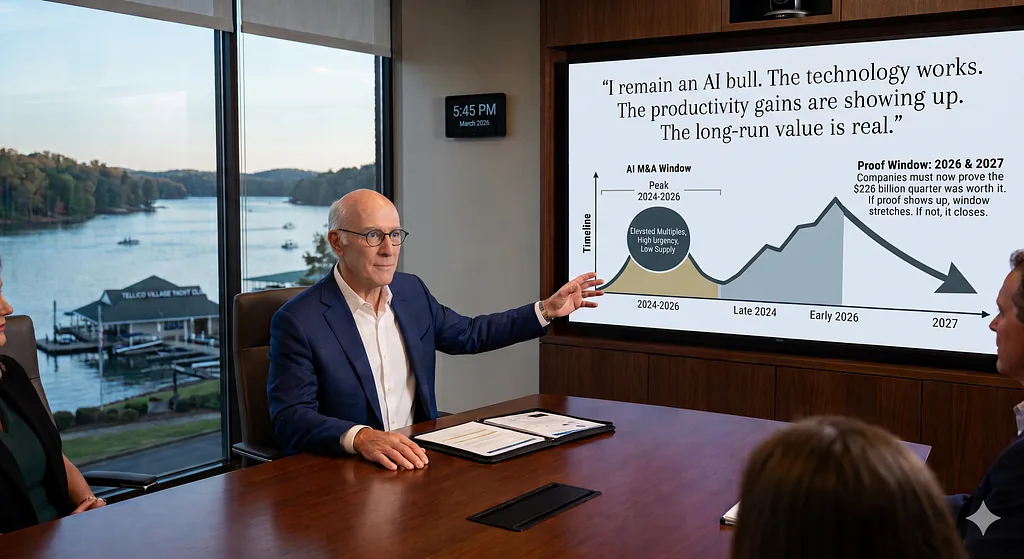
“I told you the AI premium has an expiration date. Here’s the scenario where it doesn’t expire. It detonates. More than $226 billion raised in a single quarter. Roughly $14 billion in projected 2026 operating losses from the market’s anchor company. And 45% of fund managers, in November 2025, called the AI bubble the biggest tail risk in the market. If you’re holding for a 2027 exit, this is the article you didn’t want to read.”
Three Articles, One Argument
I’ve made the same bet three times now, from three different angles.
In the first piece, I argued there’s a window right now for AI-native and AI-enabled companies to exit at a premium, and that the window won’t stay open forever. In the second, I went looking for what acquirers are actually testing for in diligence, beyond the pitch deck, and found that AI-driven headcount reduction has quietly become its own line item in the buyer’s model, one your CFO probably hasn’t built yet.
Both pieces share an assumption I haven’t stated outright until now: that the conditions driving these premiums are stable enough to plan around. This piece is where I stop assuming that and start stress-testing it.
The numbers from Q1 2026 are the largest the AI capital markets have ever produced. They’re also the clearest evidence yet that the bet underneath all of this, that AI returns will eventually justify AI prices, hasn’t been proven. It’s being made in real time, at a scale that leaves very little room for error. What happens if it goes wrong isn’t a footnote to the exit-window thesis. It’s the scenario the thesis depends on not happening.
A Quarter That Rewrote the Record Books
The numbers from Q1 2026 aren’t projections. They’re actuals. Private AI companies raised over $226 billion in the quarter, according to CB Insights. That’s more than the entire calendar year of 2025 ($217 billion), compressed into ninety days. Crunchbase’s broader accounting puts the AI share even higher: $242 billion, or 80% of all global venture capital deployed in the period. Across every startup category, Crunchbase counted $300 billion in total funding, shattering the prior quarterly record of $144 billion set in Q1 2022.
One transaction explains most of the headline. OpenAI’s $122 billion corporate minority raise, the largest private funding event on record, made up 54% of the CB Insights AI total on its own. Strip it out and the remaining $104 billion still marks a 45% jump from Q4 2025. The money is concentrated. The velocity beneath it is real anyway.
Four companies took most of it. OpenAI ($122B), Anthropic ($30B), xAI ($20B), and Waymo ($16B) absorbed roughly two-thirds of all global venture capital in the quarter. Sovereign wealth funds wrote the largest checks, not traditional venture firms. The old model, VC-led rounds with board seats attached, has given way to strategic capital from Amazon, Nvidia, SoftBank, and Abu Dhabi’s sovereign wealth funds.
OpenAI’s Financials: Reading the Numbers Correctly
OpenAI’s numbers get cited constantly. They also get misread constantly. This is worth stating precisely.
Internal projections reported by The Information put OpenAI’s operating losses at roughly $14 billion in 2026. Cash burn is a separate, larger number, one that folds in capital expenditures and infrastructure spend. That figure runs to $17 billion in 2026, climbing to $35 billion in 2027 and peaking near $47 billion in 2028. Commentators routinely treat the two as interchangeable. They are not. Conflating them overstates the loss. For valuation purposes, the operating loss is the figure that matters.
Context helps here. OpenAI’s actual 2025 results, disclosed earlier this year, showed $20.9 billion in operating losses against $13 billion in annual revenue. That figure already exceeded the 2026 operating loss projections circulating in early 2025. The company is burning through cash faster than its own forecasts expected. Internal documents point to $44 billion in cumulative losses through 2028, with a turn to profitability projected for 2029, at roughly $14 billion in net income.
The revenue trajectory is what makes the 2029 number plausible. OpenAI ended 2025 at roughly $20 billion in annualized revenue, according to CFO Sarah Friar. It’s now generating about $2 billion a month. It crossed $12 billion annualized in July 2025, a pace that took Google seven years and Facebook six. Reaching $100 billion in revenue by 2029 requires sustained growth of about 2.3x a year from current levels. Possible. Not guaranteed.
What Fund Managers Actually Said, and When They Said It
The 45% figure needs a date attached to it.
In November 2025, Bank of America’s Global Fund Manager Survey named the AI bubble the single greatest tail risk in markets, cited by 45% of respondents. That was up sharply from 33% the month before, and from just 11% in September. At the same time, 53% of those managers believed AI stocks were already in a bubble, and a record 63% called global equities overvalued.
By March 2026, the picture had moved. That month’s BofA survey showed the AI bubble falling to just 10% as the top tail risk, overtaken by geopolitical conflict at 37%, driven largely by tensions around Iran. November was a peak. It wasn’t a plateau.
That doesn’t mean the worry disappeared. The February 2026 survey found the highest share of fund managers since 2005 describing corporate AI spending as overinvestment. The concern about whether AI capex is sustainable hasn’t gone away. What changed was the ranking of risks, not the skepticism itself.
I wrote the bull case for AI M&A premiums. I still believe it. The 8.4x window is real, it has a deadline, and sellers who haven’t moved yet are leaving money on the table.
Here’s the other scenario.
The window does not compress slowly. It slams shut. Multiples normalizing is the slow version. The fast version starts when the first major AI unicorn misses its earnout by a wide margin, write-downs hit the acquiring institutions, and strategic buyers freeze. Not for good. For six to twelve months. That is enough time to do real damage.
Look at the conditions already in place. Buyer balance sheets carry AI acquisitions at valuations set during the sentiment peak of November 2025. The revenue synergies behind those deals haven’t shown up yet. OpenAI, the company everyone else gets priced against, is burning $17 billion in cash against $14 billion in operating losses in what’s supposed to be its best near-term year, and has confidentially filed for an IPO targeting a valuation above $852 billion. Once the S-1 becomes public, those numbers will be visible to everyone. Public investors will price the company on financial returns. Strategic positioning will not save the multiple.
One visible miss, at scale, in a market already flashing record overvaluation readings, could trigger a re-pricing cascade across the sector. The earnout structure, standard in AI deals precisely because buyers distrust forward revenue claims, becomes the trigger mechanism. Sellers who accepted earnout-heavy terms in 2024 and 2025 end up on the wrong side of the reset. Buyers weighing 2026 acquisitions pause and wait. The pipeline stalls.
This is not a forecast. It is a scenario worth running. The odds are not zero. A board that hasn’t stress-tested it has made an optimistic assumption without ever deciding to.
What This Means for Exit Timing
I remain an AI bull. The technology works. The productivity gains are showing up. The long-run value is real.
None of that makes the premium window permanent. The case for acting in 2026 doesn’t rest on AI M&A disappearing. It rests on the fact that the conditions producing above-market multiples right now, elevated buyer urgency, a thin supply of proven targets, and investor pressure on acquirers to show AI capability fast, are temporary by nature. Those conditions peaked between late 2024 and early 2026. Nothing guarantees they survive into 2027.
The $226 billion quarter shows extraordinary capital piling into the frontier. It also shows a market that has front-loaded its bets hard. The companies that raised that money now have to prove it was worth raising. That proof window is 2026 and 2027. The AI-premium exit window runs alongside it and depends on it.
If the proof shows up, the window stretches.
If it doesn’t, the window does not ease shut. It closes.
References
1. Bank of America. (2025, November). Global Fund Manager Survey — November 2025. Reported by CNBC: https://www.cnbc.com/2025/11/19/ai-bubble-fund-managers-say-companies-are-overinvesting-bofa-survey.html
2. Bank of America. (2026, February). Global Fund Manager Survey — February 2026. Reported by Benzinga: https://www.benzinga.com/markets/tech/26/02/50650501/ai-spending-bubble-fear-record-bofa-survey-2026
3. Bank of America. (2026, March). Global Fund Manager Survey — March 2026. Reported by Bitget News: https://www.bitget.com/amp/news/detail/12560605271825
4. CB Insights. (2026, April 14). State of AI Q1’26 Report. https://www.cbinsights.com/research/report/ai-trends-q1-2026/
5. Crunchbase News. (2026, April 1). Q1 2026 shatters venture funding records as AI boom pushes startup investment to $300B. https://news.crunchbase.com/venture/record-breaking-funding-ai-global-q1-2026/
6. R&D World Online. (2026, January 30). Facing $14B losses in 2026, OpenAI is now seeking $100B in funding. https://www.rdworldonline.com/facing-14b-losses-in-2026-openai-is-now-seeking-100b-in-funding-but-can-it-ever-turn-a-profit/
7. TechMarketBriefs. (2026, April 29). OpenAI IPO 2026: $852B valuation, risks & bull case. https://techmarketbriefs.com/pre-ipo/openai/
8. TradingKey. (2026, June 16). OpenAI annual spending hits $34B, net loss surges nearly 8-fold. https://www.tradingkey.com/analysis/stocks/us-stocks/261970281
9. Wiss. (2025, December 22). OpenAI valuation: What tech founders need to know. https://wiss.com/openai-valuation/
10. Yahoo Finance. (2026, January 21). OpenAI’s own forecast predicts $14 billion loss in 2026. https://finance.yahoo.com/news/openais-own-forecast-predicts-14-150445813.html
11. Yahoo Finance. (2025, November 18). Investment alarm bells ring: AI bubble fears have fund managers saying companies are overdoing it. https://finance.yahoo.com/news/investment-alarm-bells-ring-first-152947005.html
By Ivan Ruzic, Ph.D. · Originally published on Medium