
You’re about to get on a call with a strategic acquirer. They’ll ask about your AI architecture. They’ll ask whether your workflows depend on a model vendor’s generic API or on something your company actually owns. They’ll ask what happens to your gross margin when inference costs fall another 40%.
If those questions feel new, they are. They weren’t standard diligence two months ago. They are now.
One week in March changed the framing — not incrementally, but structurally. The releases and announcements between March 17 and March 21 didn’t extend the existing logic of AI product development — they ended one era and started another. For operators, investors, and acquirers who are still applying last year’s evaluation criteria, that gap is already showing up in how deals get priced.
The era that ended
For the past three years, the dominant AI product design question was: how do we put a better interface on top of a capable model? That question produced an entire market segment — companies built on the premise that prompt engineering, retrieval-augmented pipelines, and vertical UX layers on top of generic LLMs constituted a defensible business.
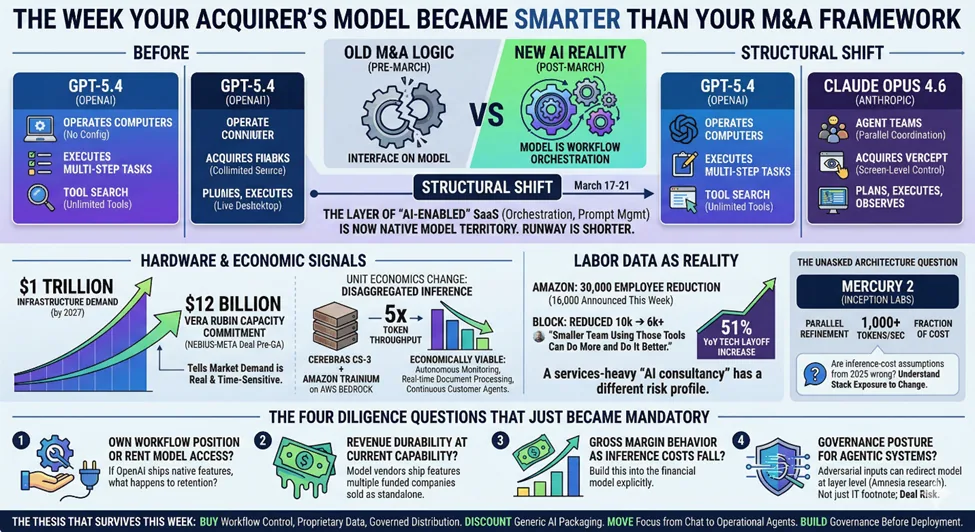
GPT-5.4 ended that premise. The model operates computers without developer pre-configuration, executes multi-step tasks across software environments without human checkpoints, and retrieves tools on demand through OpenAI’s Tool Search system, meaning the number of tools available to an agent is no longer limited by what a developer pre-loaded. The model itself has become the workflow orchestration layer.
Anthropic’s Claude Opus 4.6 arrives at the same place from a different direction. Its agent teams capability — multiple instances dividing a task, working in parallel, coordinating outputs — was previously something developers had to build themselves. Now it ships in the product. The acquisition of Vercept, which gives Claude screen-level computer control, completes the picture: an agent that plans, executes, and observes its own actions in a live desktop environment without any human checkpoint.
What these two releases mean for M&A is specific. The layer of the stack that “AI-enabled” SaaS companies occupied — the orchestration layer, the prompt management layer, the thin integration layer between a model and a customer workflow — is now native model territory. Companies that lived in that layer have a shorter runway than their last valuation assumed.
What the hardware signal actually means
NVIDIA’s GTC 2026 keynote last week produced the figure that most coverage treated as a headline number: $1 trillion in AI infrastructure demand forecast through 2027. However, the number that matters more is $12 billion — the committed Vera Rubin capacity in the Nebius-Meta infrastructure deal, signed before the platform reaches general availability.
When a hyperscaler commits $12 billion to a platform that hasn’t shipped, it’s telling the market that the demand side is real and time-sensitive. That changes the investment thesis for any target whose economics improve as inference costs fall.
The disaggregated inference architecture pairing Cerebras CS-3 systems with Amazon Trainium on AWS Bedrock points in the same direction from the cloud side. A 5x improvement in token throughput changes the unit economics of AI API calls. Use cases that were previously too expensive to run continuously — autonomous monitoring, real-time document processing, continuous customer-facing agents — are now economically viable. The addressable market for deployed AI just expanded, but it expanded in ways that favor workflow-embedded products, not generic API wrappers.
The diligence consequence: a target whose gross margin improves as inference costs fall is a different investment than one whose cost structure depends on current model-vendor pricing. Underwriting them identically is a mistake.
The labor data is no longer a projection
Amazon’s reduction of 30,000 employees — 16,000 announced this week, the rest since October — is the largest AI-displacement event in corporate history by headcount. Block’s reduction from 10,000 to just over 6,000, with AI tools named as the replacement in Jack Dorsey’s shareholder letter, is a more significant policy statement than it received in the financial press.
The language in that letter is deliberate. Intelligence tools have changed what it means to run a company. A smaller team using those tools can do more and do it better. This isn’t a claim about future productivity. It’s a description of a change that has already happened inside a public company.
The technology sector’s 51% year-over-year increase in layoffs is a statistical confirmation of what 18 months of individual announcements had already made visible. Morgan Stanley’s estimate of $3 trillion in AI infrastructure investment by 2028 confirms that capital is accelerating deployment, rather than funding research.
For M&A, the labor data matters in two directions. It changes how you model the operating leverage of an acquisition target — a services-heavy “AI consultancy” whose delivery model depends on labor arbitrage that frontier models now compress is a different risk profile than it was 12 months ago. It also changes how acquirers evaluate the target’s own workforce efficiency claims. If a target says AI has made their team more productive, the question is now specific: more productive than Amazon’s pre-displacement baseline, or more productive than Amazon’s post-displacement baseline? Those are very different answers.
The architecture question no acquirer is asking
Mercury 2, from Inception Labs, generates text through parallel refinement rather than the left-to-right sequential decoding that every major commercial LLM uses today. Throughput exceeds 1,000 tokens per second at a fraction of conventional inference costs. The model has no commercial precedent — the last serious architectural alternative to autoregressive generation shipped roughly a decade ago.
Most M&A advisors and acquirers are not tracking this. They should be, for one specific reason: the emergence of a credible alternative architecture means the inference-cost assumptions baked into current AI infrastructure valuations may need revision faster than expected.
In image and video generation, diffusion models displaced earlier architectures decisively. If a parallel dynamic plays out in language — and Mercury 2’s hybrid approach, incorporating autoregressive elements for sequence-dependent tasks, is a serious attempt to make that work — the companies building on inference-cost assumptions from 2025 may be working from the wrong base case.
This isn’t a reason to discount AI infrastructure targets. It’s a reason to understand exactly which part of the inference stack a target occupies and how exposed that position is to architectural change.
The four diligence questions that just became mandatory
While the events of this week don’t require a new diligence methodology, they do require four additions to the one you already use.
Does this target own workflow position or rent model access? The distinction matters now in a way it didn’t when all frontier models operated through chat interfaces. A target whose product is embedded in customer workflows — where the AI automates a specific process, integrates with the customer’s data environment, and creates measurable output — survives model commoditization. A target whose product is a layer between the customer and a generic API doesn’t.
Test this specifically: if OpenAI or Anthropic ships a native version of the target’s core feature, what happens to retention? This is a story we’ve seen played out before.
What is the revenue durability at current model vendor capability? This week, OpenAI and Anthropic each shipped features natively that multiple funded companies were charging for as standalone products.
That will continue — model vendors are not done expanding their native capability sets. Any acquisition thesis that depends on frontier models remaining less capable than today is already wrong.
How does gross margin move as inference costs fall? The Cerebras-AWS throughput improvement and NVIDIA’s factory-scale deployment economics both point toward continued inference cost compression. A target whose margins expand with falling compute costs has a different trajectory than one whose business model requires current compute pricing. Build this into the financial model explicitly.
What is the governance posture for agentic systems? Systems that operate computers autonomously — and both GPT-5.4 and Opus 4.6 now do this out of the box. But they create security and liability exposures that existing enterprise governance frameworks weren’t written to address. The Amnesia research paper, published the same week, demonstrated that adversarial inputs can steer LLM internal states at the layer level, effectively redirecting what a model attends to mid-task.
A model that answers a question incorrectly is a nuisance, but an agent that’s adversarially redirected while managing a financial workflow is a different category of problem. Governance and security posture is no longer an IT footnote in diligence. It’s a deal risk.
The thesis that survives this week
The acquisition logic that holds across everything that happened in March is simple to state and harder to execute: buy workflow control, proprietary data positions, and governed distribution. Discount generic AI packaging aggressively, regardless of how it performed in the previous funding environment.
For corporate strategy, the question is much the same. The center of gravity has moved from chat interfaces to operational agents. The value in the next wave doesn’t come from buying more CoPilot seats. It comes from identifying the workflows where agents can act — where delay, repetition, document volume, or cross-system handoffs are highest. And from building the governance layer before deployment, not after the first incident.
The infrastructure being built this month is designed to last decades. The governance frameworks that need to address it will require complete rebuilding within years.
The companies that come out of this period well are the ones that update their frameworks before the diligence call, not during it.
Sources: OpenAI GPT-5.4 release documentation; Anthropic Claude Opus 4.6 product announcement and Vercept acquisition; Google Gemini 3 series release; NVIDIA GTC 2026 keynote; Nebius-Meta infrastructure deal reporting; Inception Labs Mercury 2 technical disclosure; Amazon Q1 2026 workforce announcements; Block shareholder letter; Morgan Stanley AI infrastructure investment estimates; Amnesia adversarial LLM research paper.
By Ivan Ruzic, Ph.D. · Originally published on Medium