
How the Claw ecosystem is bifurcating software company valuations — and what mid-market founders need to do before their next transaction.
Let’s start with a number.
100,000.
That’s how many GitHub stars OpenClaw accumulated in roughly one week in early 2026. Most respected open-source projects only reach that milestone over years of steady adoption. OpenClaw did it in days — and the developers who starred it didn’t simply file it away. They immediately began rebuilding the concept in Rust, Go, Python, and bare-metal environments, treating the original version as a starting point rather than a finished product.
If you lead a software company and that number doesn’t concern you, you’re not thinking about it correctly.
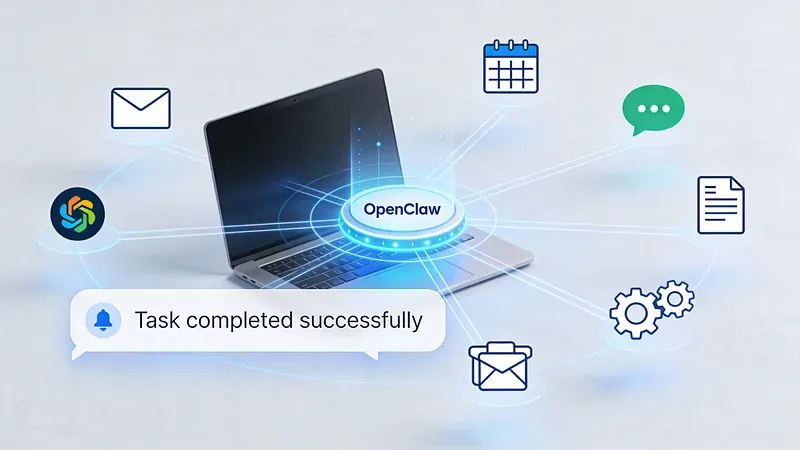
OpenClaw is agentic software that runs on your own machine, and optionally on a remote virtual private server. It connects directly to the tools your business already uses: email, calendars, messaging platforms like Slack and WhatsApp, billing systems, support inboxes, and automation workflows. It reads, triages, schedules, summarizes, and triggers actions through ordinary chat interfaces, without sending your organizational data to any third-party cloud platform.
What OpenClaw triggered isn’t a programming language trend. It’s the emergence of a new category of software infrastructure — “local-first” AI agents that run within an organization’s own security perimeter, connect directly to business workflows, and operate without routing sensitive data through centralized cloud platforms.
The local-first distinction is the point. Your data stays inside your security perimeter, and you control what the agent can access and what record it leaves behind. That’s a fundamentally different operating model than the AI tools most organizations have been evaluating — and it’s precisely why developers responded to it the way they did.
The broader framework family that grew from OpenClaw — ZeroClaw, PicoClaw, NanoClaw, TinyClaw — represents purpose-built engines, each optimized for a different combination of engineering requirements and deployment constraints.
The technology is real and it’s moving fast. It’s already changing how software companies get valued, acquired, and assessed during due diligence.
This article is about what that means for founders specifically — and what the decisions you make in the next twelve months will cost you, or earn you, in your next transaction.
Your Engineering Moat Is Being Stress-Tested
One of the most disorienting consequences of the Claw ecosystem is what it does to the economics of building software.
The workflow that once required a senior engineering team — defining architecture, writing service logic, deploying to production — can now be executed by a non-technical founder who knows the right vocabulary.
The documentation on the Claw family describes a five-step process:
1. choose the right engine for the job,
2. set up a cloud development environment,
3. instruct an AI agent on the architectural constraints,
4. iterate by feeding error messages back into the conversation, and
5. deploy through one-click platforms.
This means PicoClaw on Railway, NanoClaw on Streamlit Cloud, and OpenClaw on Vercel (or equivalent).
A non-technical founder can now deploy a service capable of handling 10,000 requests per second. Today. Without a senior engineer in the room. That is not a hypothetical future capability. It’s a documented outcome from early 2026.
Here is what this means for your valuation.
The labor costs embedded in your company’s assessed worth — engineering headcount, development runway, the estimated cost for a competitor to replicate your feature set — are being compressed by the same technology wave that is making your product easier to build.
That compression hits from two directions at once:
· new competitors can reach feature parity faster and more cheaply than they could two years ago, and
· acquirers evaluating your company will increasingly discount engineering cost structures that have not adapted to AI-assisted development.
The companies that survive this compression aren’t the ones with the most features. They’re the ones with positions that can’t be replicated by an AI agent following a specification: domain-specific data, regulatory certifications, workflow integrations that took years to build and certify, customer relationships forged through operational performance in high-stakes environments.
If your competitive position rests primarily on code complexity, your current valuation may not reflect your actual exposure.
The Due Diligence Checklist Has a New Section
Standard M&A technical diligence has a well-established structure: code quality, security posture, architecture scalability, infrastructure cost, team depth, technical debt.
Buyers have run that checklist for years. It’s now incomplete.
The more sophisticated strategic acquirers — particularly those in financial services, technology, healthcare IT, industrial automation, and defense-adjacent sectors — are adding a layer of questions that most mid-market founders are not prepared to answer.
These questions don’t appear on the traditional checklist, but they are material to deal pricing and to post-acquisition integration risk. The answers that emerge under diligence pressure are rarely as clean as the answers that founders discover and address proactively.
1. What AI agent layer is embedded in your production stack, and what permissions does it hold?
An agent connected to your billing system, customer database, and support inbox with over-broad command permissions is not a productivity tool; it’s an unmanaged liability.
Early Claw deployments have documented specific failure modes: misconfigured tunnels exposing sensitive endpoints, command allow-lists enabling unintended execution, inadequate separation between experimental and production environments. A buyer discovering these issues after the LOI will reprice the deal. Discovery after close will trigger indemnification claims.
2. Is your sandboxing model documented and enforced?
ZeroClaw-based architectures enforce path-jailing and command allow-lists by default — an agent can only execute explicitly approved commands in explicitly approved directories. If your AI agent layer does not operate with equivalent specificity, your security posture has a gap that a diligent technical reviewer will find. The question is whether they find it before or after you sign.
3. What is the attribution chain for agent-generated code in your codebase?
PicoClaw, the Go engine in the Claw family, was reportedly 95% generated by AI agents. If significant portions of your production codebase were similarly generated without clear human review checkpoints and attribution logs, you face two distinct problems: an audit trail that a buyer cannot reconstruct, and potential liability exposure when that code fails in production.
Neither is a position you want to negotiate from.
4. Are there human review checkpoints before agents interact with production systems?
The risk profile of AI agents escalates sharply by use case. An agent that drafts email responses represents a different category of risk than an agent watching live data feeds and interacting with production infrastructure before human review. The governance gap between those two deployments is significant. Buyers who understand the technology will measure that gap precisely.
Founders who can answer all four questions clearly, with documentation, move through technical diligence faster and with fewer surprises. Founders who can’t will face a longer process, a price adjustment, or both.
The Valuation Split Is Already Happening
The Claw ecosystem is driving a bifurcation in how mid-market and lower mid-market software companies are valued. The dividing line isn’t company size. It’s not revenue growth rate. It runs between companies that have made deliberate, defensible architectural choices about their AI agent layer and those that have not.
The premium tier. These are companies that have built production deployments of AI agents with proper sandboxing, audit trails, and domain-specific operational integrations in regulated or high-stakes verticals — financial services, healthcare technology, industrial automation, defense-adjacent applications, logistics and supply chain.
What makes them valuable isn’t that they use AI. It’s that they’ve accumulated the operational experience of running AI agents adjacent to critical business processes, with a track record to prove it. That experience isn’t in the documentation. It lives in the organizational knowledge built when something went wrong in production and the team diagnosed and fixed it correctly. Strategic acquirers in regulated verticals are paying a scarcity premium for that experience because building it internally requires time that competitive pressure does not allow.
The local-first architecture these companies run also creates a structural advantage in regulated procurement. GDPR, HIPAA, and emerging AI governance frameworks all move toward operator-controlled data and auditable AI behavior. A software company already operating within those parameters faces lower compliance costs and shorter sales cycles with regulated customers — a durable revenue quality premium that sophisticated acquirers recognize and price accordingly.
The repriced tier. These are companies with deep dependencies on centralized AI platforms: architectures that route sensitive customer or operational data through third-party cloud AI services with opaque retention policies.
The repricing arrives from two directions. The first is regulatory pressure, which will increase the cost of those dependencies as AI governance frameworks mature. The second is competitive pressure from companies built on local-first infrastructure, which will erode pricing power with regulated customers who can’t accept the data handling that centralized architectures require.
Neither pressure arrives all at once, but both are already present and accelerating.
The middle — where most companies currently sit. These organizations have run AI pilots and added AI language to their marketing materials, but haven’t made deliberate architectural choices about agent layers, sandboxing, governance, or data sovereignty. They’re waiting for the technology to stabilize.
That hesitation is understandable. It’s also a strategic miscalculation. The technology is stabilizing, the regulatory environment is forming around it, and acquirers who understand this are already evaluating targets through the lens described above.
Companies still in the evaluation phase are losing ground on a dimension that will determine a meaningful portion of their exit valuation.
Who’s Looking and What They’re Paying For
The companies worth acquiring in this environment are not the ones with the most AI product features. Acquirers who have done their homework know that features are increasingly replicable. What they can’t replicate quickly is the specific profile that commands a premium right now.
That profile looks like this:
· deliberate, documented architectural choices about the AI agent layer
· governance infrastructure — audit logs, sandboxed execution, human review checkpoints — that a buyer can verify and build on
· domain-specific operational data that makes an AI agent genuinely useful in a defined context rather than impressive in a demo, and
· a vertical where local-first, sovereignty-preserving architecture creates a compliance advantage with target customers
That combination is scarce. Most mid-market software companies don’t meet it. That scarcity is what creates the acquisition window.
Strategic acquirers in financial services technology, healthcare IT, industrial automation, and defense-adjacent sectors are actively searching for this profile. They’re not finding many matches, but the companies that do match are receiving attention — and offers that reflect the scarcity.
The window is not permanent. As the technology matures and more companies make deliberate architectural investments, the scarcity premium will compress. Acquirers who can’t find the right target externally will build the capability internally. The regulatory frameworks that currently create the compliance premium will become table stakes rather than differentiators.
For founders considering a transaction in the next 18 to 36 months, the question is whether your company is seen as a scarce asset or as one of many. The architectural and governance choices you make in the next twelve months will determine a meaningful portion of that answer.
The Practical Agenda
Here are four moves, and each one matters.
Audit your AI agent layer as a buyer would — before a buyer does. Document what your agents can access, what they can execute, and what record they leave behind. If you can’t answer those questions from existing documentation today, a technical diligence process will surface them under time pressure with the other party watching. Answers discovered under pressure are rarely as favorable as answers discovered and resolved proactively.
Make architectural choices deliberately, then document the reasoning. The difference between a company that chose strong sandboxing because it understood the security model and a company that arrived at a similar configuration without understanding why is invisible in a product demo. It’s very visible in technical diligence. Buyers are evaluating the judgment that produced the outcomes, not just the outcomes themselves.
Build for the regulatory environment that is forming, not the one that currently exists. The AI governance frameworks being written now will require operator-controlled data, auditable agent behavior, and clear attribution chains for AI-generated decisions. Companies already operating within those parameters will face lower compliance costs and faster procurement cycles in regulated markets. Retrofitting that infrastructure under regulatory pressure is substantially more expensive than building it now.
Know your position in the bifurcation. Assess honestly whether your current architecture and governance posture place you in the premium tier or the repriced tier. If the answer is the repriced tier, you have a defined problem with a defined solution. The solution requires time and deliberate investment — both of which are available right now.
Neither will be available at the same cost in eighteen months.
The Bottom Line
The Claw ecosystem is a leading indicator. It tells you where software infrastructure is heading, what sophisticated acquirers are beginning to require, and which companies will transact at the best terms as this shift accelerates.
The mid-market software companies that achieve the strongest exits over the next several years won’t be the ones that built the most features or raised the most capital. They’ll be the ones that understood, early enough, that AI agents are infrastructure — and made the architectural and governance decisions that treated them accordingly.
That understanding is not yet widely distributed. The window created by that gap is real. It’s open.
It is also narrowing.
By Ivan Ruzic, Ph.D. · Originally published on Medium