
SAP just told investors it’s freezing hiring and travel to fund its AI buildout. That’s not a savings story — it’s a public admission of where AI headcount cuts actually go. And it isn’t the bottom line most boards are expecting.
In an earlier article, I said that your acquirer has a headcount line item your CFO doesn’t. I also told you what the wrapper, the training data, and the inference bill actually cost after close, and I closed that piece with a promise: a third question was coming, about whether AI savings fund growth or just disappear into a slide with an upward pointing arrow.
Here’s the answer — the savings are real — they just aren’t landing where the board thinks. That’s because a growing number of companies are quietly funding someone else’s capex with them instead of their own margin.
The Smoking Gun
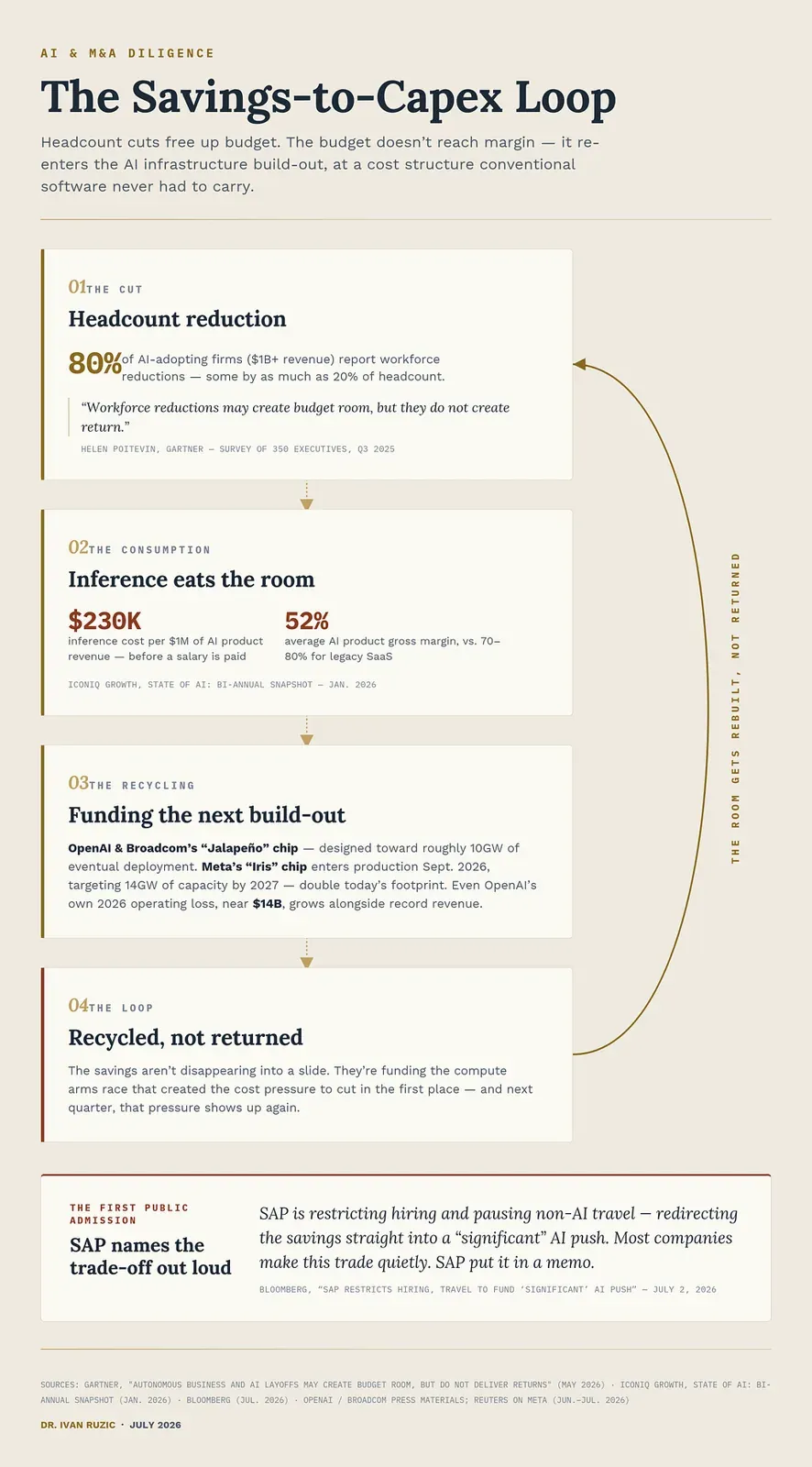
SAP gave us one of the cleanest examples on record. In early July, the company told investors it’s restricting hiring and travel specifically to fund what it called a “significant” AI push. Read that plainly: this isn’t AI-driven savings flowing into growth investment or shareholder return. It’s operating budget — headcount and T&E, the two levers every cost-conscious CFO reaches for first — moving directly into AI capital spend, disclosed in public.[1]
SAP isn’t unusual. It’s just honest about the mechanism. Most companies making the same trade-off don’t put it in a press release — they fold it into “reinvestment in strategic priorities” and let the board infer the rest.
SAP’s disclosure is useful precisely because it names what the number actually is: a transfer, not a saving.
What Gartner Actually Found
I used this data previously, and it’s worth repeating because it’s what the whole argument turns on. Gartner surveyed 350 executives at companies with at least $1 billion in revenue, all of them already piloting or deploying AI agents. Eighty percent had reduced headcount, some by as much as 20 percent of their workforce. Yet the companies that cut deepest posted virtually the same financial returns as the companies that cut the least, and several of the lighter cutters actually did better.[2]
Gartner’s own lead analyst drew the line as cleanly as it can be drawn; layoffs create budget room, not return. Those are different things, but most boards are still treating them as the same line item.
Budget room certainly isn’t nothing. It’s real cash freed from the payroll line. However, the question the Gartner data leaves open — the one I said I’d come back to — is what happens to that budget room once it’s created. Recent evidence says it’s being spent on infrastructure, not returned as margin.
Where the Room Is Going
Look at what the frontier labs did with their own cost structure in the same window SAP made its announcement.
On June 25, OpenAI and Broadcom revealed Jalapeño, their first co-designed AI inference chip — engineered in a compressed nine-month cycle and intended to scale toward roughly 10 gigawatts of eventual deployment, enough electricity to power a mid-sized country.[3]
Two weeks later, Meta confirmed a new AI chip entering production in September, with an internal target of 14 gigawatts of capacity next year and a stated goal of doubling computing capacity.[4]
That isn’t R&D spend in the traditional sense. It’s industrial-scale capital expenditure on power, silicon, and packaging — the kind of build-out that shows up on a balance sheet for a decade, not just a quarter. And it’s being funded, in real part, by the same cost reductions that headcount conversion was supposed to hand back to shareholders directly.
The inference economics makes the loop explicit. ICONIQ Growth’s 2026 data put the cost of running these systems at roughly $230,000 in inference cost for every $1 million of AI product revenue — before a single salary is paid. This means that AI product gross margins are landing around 50 to 55 percent in 2026, against the 70 to 80 percent that defined a generation of conventional SaaS.[5] Every dollar a company saves by converting a role to an agent is a dollar that then has to cover a meaningfully more expensive cost of goods than the software business it’s replacing.
Anthropic’s attempt in June to split programmatic agent usage from subscription pools — moving it onto metered, non-rollover credits billed at API rates — is the industry’s own admission that agentic compute is now a distinct and expensive economic category. It has to be priced and budgeted on its own terms, not absorbed as a rounding error inside a flat-rate seat.[6]
Put these data points together. Headcount savings create budget room. Inference and infrastructure costs consume that room at a rate conventional software never did. Frontier labs are racing to build gigawatt-scale capacity to keep the cost curve from becoming unworkable.
The money isn’t disappearing. It’s being recycled into the arms race that produced the savings in the first place.
The OpenAI Mirror
To see where this lands at scale, look at the company setting the pace for everyone else’s cost structure.
OpenAI’s internal projections put 2026 operating losses at roughly $14 billion. Cash-burn estimates have moved materially upward over the past year: a September 2025 forecast put annual cash burn at $17 billion (2026), $35 billion (2027), and $45–47 billion (2028). Reporting from February 2026 shows those figures revised upward to roughly $25 billion (2026) and $57 billion (2027), with cumulative 2026–2029 burn now projected near $218 billion — about $111 billion higher than the prior internal projections.[7]
This is a company with revenue growth most boards would kill for and still burning cash at an accelerating rate, because the infrastructure bill scales faster than the top line it’s meant to support.
If the company with the fastest revenue growth in the sector’s history can’t outrun its own capex, the assumption that a mid-market enterprise’s AI savings will simply drop to the bottom line deserves some real scrutiny.
What This Means in Diligence
I said in June that sellers need to put a workforce map, a conversion roadmap, and a retention story in the data room before the LOI arrives. Now add a fourth document: a trace of where the savings actually went, quarter by quarter, on the general ledger — not the model, the actuals.
A seller who can show that converted headcount cost dropped to EBITDA, funded specific growth initiatives, or reduced customer-facing pricing is telling a buyer something concrete and verifiable. A seller who can only point to a lower headcount number and a flat or declining margin is telling a buyer that the savings went somewhere else — most likely into the inference and infrastructure bill required to keep the AI running at all.
That’s not a disqualifying answer. It might even be the right operational choice. But it’s a different multiple than the one the original AI-conversion story implied, though, and a sophisticated buyer will now ask the question directly instead of assuming the arrow points the way the deck says it does.
The Earnings Season Test
Q2 earnings arrive over the next few weeks, and this is the first reporting cycle where the dynamic becomes visible in hard numbers rather than survey data.
Companies that told investors in Q1 that AI-driven headcount conversion would expand margin now have to show that expansion. Watch for two things: whether opex reductions are actually reaching operating margin, and whether capex lines — AI infrastructure, compute commitments, chip development — are absorbing the difference before it gets there.
SAP already told you which way it’s betting. Whether the rest of the market follows the same pattern, or proves Gartner’s light cutters right, is the number that will actually move multiples this quarter — not the headcount figure, the margin one.
What I’m Watching Next
The savings-to-capex loop I’ve described here is a management choice, not a red flag on its own: a bet that the infrastructure buildout is worth more right now than the near-term margin.
The problem is that almost nobody is disclosing the trade-off the way SAP did, which means boards, investors, and acquirers are underwriting a return that, in a meaningful share of cases, was never headed for the bottom line in the first place.
I suspect that the companies that name the trade-off honestly will earn a premium for candor. The ones that don’t will get caught in exactly the earnings-season gap this piece describes.
References (APA)
Infographic generated by Claude
[1] Moneycontrol. (2026, July). SAP restricts hiring, travel to fund “significant” AI push. https://www.moneycontrol.com/artificial-intelligence/sap-restricts-hiring-travel-to-fund-significant-ai-push-article-13964514.html
[2] Gartner. (2026, May 5). Gartner says autonomous business and AI layoffs may create budget room, but do not deliver returns. https://www.gartner.com/en/newsroom/press-releases/2026-05-05-gartner-says-autonomous-business-and-artificial-intelligence-layoffs-may-create-budget-room-but-do-not-deliver-returns; Fortune. (2026, May 11). AI isn’t paying off in the way companies think. https://fortune.com/2026/05/11/ai-automation-layoffs-gartner-study-roi/
[3] The New York Times. (2026, June 24). OpenAI and Broadcom unveil the Jalapeño chip. https://www.nytimes.com/2026/06/24/technology/openai-broadcom-chip-jalapeno.html; OpenAI. (2026, June 24). OpenAI and Broadcom announce strategic collaboration. https://openai.com/index/openai-and-broadcom-announce-strategic-collaboration/
[4] Reuters. (2026, July 9). Meta to put AI chip into production in September, looks to double computing capacity. https://www.reuters.com/world/asia-pacific/meta-put-ai-chip-into-production-september-it-looks-double-computing-capacity-2026-07-09/
[5] ICONIQ Growth. (2026). State of AI: Bi-annual snapshot.
[6] The Digital Applied. (2026, June). Anthropic Claude credit overhaul, June 15, 2026. https://www.digitalapplied.com/blog/anthropic-claude-credit-overhaul-june-15-2026
[7] R&D World Online. (2026, January 30). Facing $14B losses in 2026, OpenAI is now seeking $100B in funding. https://www.rdworldonline.com/facing-14b-losses-in-2026-openai-is-now-seeking-100b-in-funding-but-can-it-ever-turn-a-profit/; TechMarketBriefs. (2026, April 29). OpenAI IPO 2026: $852B valuation, risks & bull case. https://techmarketbriefs.com/pre-ipo/openai/
By Ivan Ruzic, Ph.D. · Originally published on Medium