Weekly decision brief on geopolitical developments and U.S. economic exposure. Reporting window November 1 to 6, 2026.
The world’s trade routes are full of paperwork. This is usually dull, which is why it matters when it stops being dull. On November 4, the United States put a new set of names, companies, and vessel-related practices into the sanctions spotlight around Iranian petroleum. Treasury targeted an India-based network it said sold false flags and certifications to sanctioned vessels and also designated a Turkish ground-services firm. OFAC followed with an alert aimed at maritime service providers. The event does not prove that a barrel of oil vanished from the market. It does show that the cost of deciding which cargo, vessel, insurer, port agent, or payment chain is acceptable has gone up.
That distinction separates a real economic risk from a dramatic headline. Sanctions pressure travels first through compliance departments, insurers, trade-finance desks, and vessel operators. A false flag can alter the answer to basic questions: Which country is responsible for the vessel? Is its paperwork credible? Will an insurer cover it? Can a bank process payment? The immediate result is often delay, extra diligence, or a refusal of service. The larger macro effect comes only if such decisions change routes, physical exports, or freight pricing for long enough to matter beyond the sanctioned trade.
Treasury’s own language made the point unusually plain. It warned that false flags can leave vessels without valid protection and indemnity insurance and can expose service providers to sanctions risk. Its alert urged insurers, financial institutions, and other maritime providers to look for specific indicators. That is a commercial signal as much as a policy signal. It is relevant to operators far from the Gulf because maritime documentation, financing, and insurance are international businesses. The near-term U.S. effect is still better described as targeted friction than a national inflation shock.
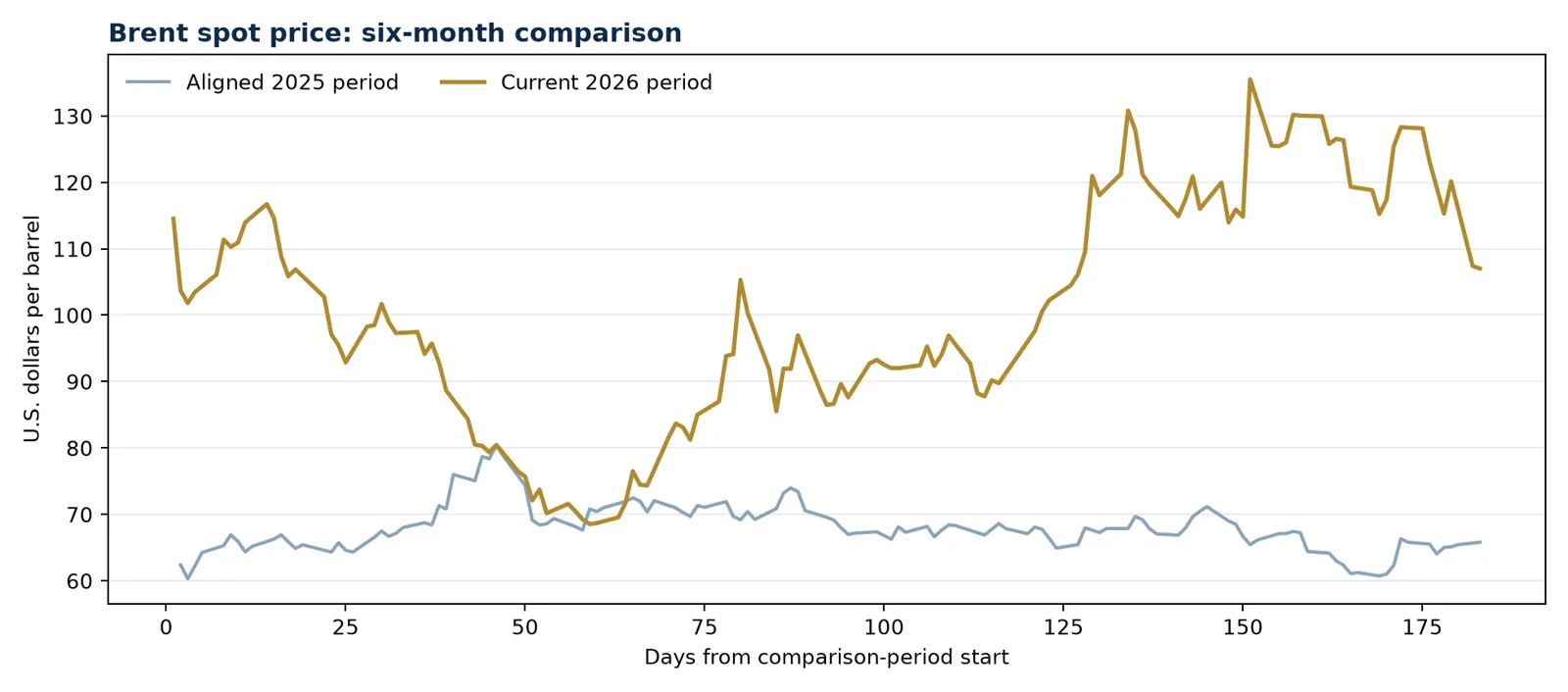
Oil prices give useful context, with a caveat. The Brent chart in this report uses spot data from FRED, ending at the last available observation on October 27. The series rose sharply during the spring and again in early autumn before remaining volatile. Spot prices do not tell us whether the latest sanctions action has created a supply shortage. Nor can a chart distinguish a political risk premium from a physical shortage. It is an anchor, not a verdict. For that verdict, analysts need shipping data, export numbers, refinery runs, tanker rates, and insurer circulars.
Ukraine shows the other side of the same lesson. A local diplomatic development can coexist with a hard operating environment. The White House said representatives of Russia and Ukraine would gather after a localized ceasefire around Oleshky. Ukraine’s president then warned of intelligence indicating another Russian attack focused on energy assets, bridges across the Dnipro, and civilian infrastructure. Canada, Austria, and Germany all described support for Ukraine in terms that included energy resilience, recovery, and humanitarian assistance. The local arrangement may matter for the people inside it. It does not remove the wider winter exposure for Ukraine or Europe.
The economic channel from Ukraine to the United States is mostly indirect. Damage to power infrastructure raises repair and equipment needs. It can tighten European energy security, shape defense spending, and affect sentiment toward European risk assets. A serious Black Sea disruption would add a more direct food and freight channel. The evidence gathered this week supports concern over resilience and repair. It does not support a claim that a broad settlement is at hand, or that a new region-wide energy crisis has already begun. That is a modest conclusion. Modesty, like electricity, becomes more attractive when it is in short supply.
In the Indo-Pacific, Taiwan’s defense ministry supplied a routine but useful stream of data. It reported PLA air and maritime activity on several days, including 49 aircraft sorties on the November 3 release. The numbers are relevant because Taiwan sits near a dense set of technology and shipping dependencies. They do not, by themselves, establish a blockade, an invasion warning, or a disruption to semiconductor supply. The market error would be to treat every reported sortie as a supply shock. The planning error would be to assume that a change in activity would announce itself politely in advance.
For firms with hardware, semiconductor, marine, and logistics exposure, the indicator list is practical. Monitor official navigation notices, declared exercises, carrier advisories, producer statements, and port or air-cargo schedules. A credible commercial signal needs some evidence of changed operations. The same rule applies to the Iranian measures. A designation is real; a claim about broad oil disruption requires additional facts.
The Western Hemisphere supplied a narrower, more legalistic set of signals. State described a meeting with Venezuela’s foreign minister as part of a three-phase process that includes stabilization, economic recovery, political reconciliation, and democratic transition. Days later, State and OFAC broadened Cuba-related designations and identified additional sectors under the relevant executive order. Those actions may matter to particular shippers, technology vendors, electronics suppliers, and financial institutions. They are unlikely to move U.S. macro variables by themselves. Their value to decision makers is as a reminder that sanctions risk can widen through sectors as well as named parties.
The week’s humanitarian evidence matters too. The United Nations said that nearly 310,000 people had left their homes in Yemen since August and that basic-goods prices in Taiz had risen by as much as fivefold as cargo transport was pulled back. The direct channel to U.S. growth is slight. The broader risk is regional instability, humanitarian funding pressure, migration, and the possibility that local insecurity reaches nearby maritime routes. The UN’s Libya mandate renewal is therefore more than paperwork, though it is not a cure for Libya’s political divisions.
The operating conclusion is simple. Treat formal actions as facts. Treat threatened disruptions as risks. Then look for the evidence that connects the two: vessel movements, policy notices, insurer decisions, outage data, shipment delays, and verified changes to schedules. The burden of proof for an economic shock should be higher than the burden of proof for an alarming headline. That is not complacency. It is how a risk register avoids becoming a collection of expensive adjectives.